Friday, June 24, 2005

BRASCAN (Renamed BROOKFIELD) REPLACES WEYERHAEUSER IN BC FORESTS

As a young boy I spent many hours paddling my father around in a canoe while he fly fished the lakes in Northwest Bay logging division. Sometimes we camped overnight or brought friends and relatives for picnics, swimming, or skating. This father’s day week-end the roads to Boomerang, Okay, Round, Cottel, Off, and Kidney Lake were closed to the public due to industrial logging on this privately owned land.

One of the largest business deals in BC has gone almost unannounced. Driving down the highway just south of Parksville you may notice that the green Weyerhaeuser sign has been replaced by a blue sign that states “Island Timberlands” Only those in the know would notice that the odd symbol on the left is the corporate logo for Brascan who announced:

“Toronto, CANADA, May 30, 2005 – Brascan Corporation (NYSE/TSX: BNN) today announced that it has completed the acquisition of Weyerhaeuser's British Columbia coastal business for approximately C$1.2 billion plus working capital, a transaction which included: 635,000 acres of high quality, freehold timberlands; and five saw mills, two remanufacturing facilities and 3.6 million m3 of associated annual Crown harvest rights. “

Locally, Brascan has just bought land that is under serious contention in Cathedral Grove, Hamilton Marsh, on the Floodplain of the Little Qualicum River, on the slopes of Mt Arrowsmith including the Judge’s Route. Local communities and the public have expressed serious concerns about protecting these sensitive ecosystems.

Will Brascan protect these relatively small areas of privately owned land or will this corporation log these highly sensitive forests for the sake of profits? It is posted at www.brascancorp.com “At Brascan, we pride ourselves on contributing positively to the communities in which we operate. From an environmental perspective, that means we are continually striving to minimize our impact on the environment...”

Will Brascan continue to use helicopters to dump thousands of tons of chemical fertilizer into the Englishman RIver Watershed in the same way that Weyerhaeuser and TimberWest did last year? If you would like to get in touch with Brascan to find out their plans regarding local wilderness managed by Island Timberlands, please contact Reid Carter, Managing Partner at (604) 661-9142 or e-mail: rcarter@brascanam.com

Worthy of note is that, while the corporate change means upper management has been replaced, the middle management positions are still filled by most of the same people who worked for M&B, Weyerhaeuser, and now Brascan. Logs are still being exported while more local workers have been laid off in the past month.

“Brascan Corporation is a global asset manager focused on property, power and infrastructure assets. With $40 billion of assets owned and under management, the company owns 70 premier office properties and 130 power generating plants. The company is inter-listed on the New York and Toronto stock exchanges.“

The corporate message is often hard to understand such as; “With a focus on strategic investments in fee simple timberlands in Canada, the United States and Brazil, our Fund investments may also include monetization or securitization of crown timberlands in Canada.” My simple translation is: We will cut down trees on private land as well as on publicly owned land to make lots of money.

Brascan goes on to state: “Approximately 13,000 hectares of lands are viewed to have greater value in non-timber use, located on Vancouver Island and the Mainland. It is expected that the constantly growing rural-urban interface will result in ongoing land sale opportunities.”

Weyerhaeuser sold off a lot of ‘timberland’ as real estate, logged many millions of cubic meters of old growth forest on public land, dumped tons of chemicals into the watersheds of this province, and donated millions of dollars to the BC Liberals. Weyerhaeuser also helped to establish new presidents in the Supreme Court of Canada with regards to First Nations’ land claims and helped to galvanize the environmental community. It remains to be seen how Brascan will act in BC.

Friday, June 10, 2005

COMMUNITY HISTORY INSTILLED IN ERRINGTON OAK

A single English Oak tree stands in front of the ‘old’ Errington Elementary School on Grafton Avenue. Other trees and scrubs grow without the presence of the children they were meant to keep company. I attended all the grades at that school and remember gathering leaves from those trees for art collages. I played around those trees and climbed them after school was out. I even remember the planting of several of those trees because they are significant to many in the community as a reminder of those who have passed on. Thousands of children have similar memories of those trees.

Now that the Navy Cadets of Canada have bought the ‘old’ school property, there is some hope that the trees planted by the community will be allowed to grow and prospers. After all one of these trees is of great historical significance to Canada as well as the community of Errington.

The English Oak tree is of particular historical significance since it was given to the Province of British Columbia by the King of England George VI, upon his coronation in 1936 along with one tree for each of the other 10 provinces in Canada. That Oak tree was planted in Errington by a 12 year old Earl Ware in the spring of 1937.

The very nature of trees is that they can outlive the people that planted them. In fact there are trees growing on Vancouver Island that pre-date even our own calendar. Trees have been used for centuries to mark special occasions, people, and historic events. However, trees remain silent and over time the memories they were meant to preserve fade into the past.

People living in Errington when the school was first built may have thought that the publicly owned land would remain a center piece of the community. A plaque should be established by the tree to remind people why it was planted.

Henry VIII cut down the Oak forests of England to build the man-of-war fleet that expanded the British Empire to all corners of the globe. Today a single oak tree, seeded from the remains of that decimated forest, stands tall before what will become headquarters for navel cadets in this community.

Today the Errington Cedar Mill dominates the center of the community of Errington. The surrounding drinking wells have been poisoned and water runs black in the ditches. The noise of the saws, chippers, debarker, loaders, and trucks can be heard everywhere in Errington from 6 am until late into the night and often on week-ends. Many of the Yellow Cedar logs being cut in Errington today are coming from the Upper Walbran Valley, Crown Land designated as a Special Management Zone.

This spring I hiked through the Alpine forest just outside the Carmanah Walbran Provincial Park and looked at those same Yellow Cedar trees. The specific type of ancient rainforest that they live in is a red-listed plant community on Vancouver Island. Extremely steep slopes rise up to a long alpine ridge complete with small lakes and ponds. Some of those trees were over 1000 years old and seeded before the first crusade. Standing beside the stump and log of an ancient yellow cedar tree with growth rings so tight that they can only be distinguished by polishing the wood and using a magnifying glass to count them, we estimate that a 3 foot wide stump is all that remains of an 800 year old Chamaecyparis nootkatensis.

I have been hiking and filming in the ancient rainforests of Vancouver Island for many years and invite you to join me at the Errington Community Hall for a ‘back by popular demand’ screening of my half hour film “THE ART OF RAINFORESTS” Friday June 17 and Saturday June 18 at 8 pm.

Friday, May 27, 2005

DEMOCRACY CAN HELP ENVIRONMENT?

The new political landscape in BC may provide an opportunity for change in the way we treat the natural environment in this province.

In 2001 Gordon Campbell lifted the moratorium on the trophy hunting of grizzly bears then changed the Ministry of Environment into the Ministry of Water, Land, and Air Protection.

WLAP introduced pay-for-parking at most Provincial Parks around British Columbia. The result has been a dramatic 25% decline in the number of people visiting our parks. Locally that includes parks at Rathtrevor, Englishman River Falls, and Little Qualicum Falls. Revenue goals resurrected plans to bulldoze the floodplain of the Cameron River to install a 2 hectare parking lot. Intense public opposition and a BC Supreme Court ruling denied the Liberals from removing a protest that has been continuous for 15 months in Cathedral Grove.

In 2004 the Campbell government took full credit for opening or expanding a series of parks created by the former NDP government. BC Liberals plan to put privately financed lodges, complete with long-term leases, into provincial parks. Over 20 million people visit BC parks on an annual basis, contributing half a billion dollars to the provincial economy. Over the past four years the budget to BC parks was cut by 30%.

Provincial parks and protected areas have been opened to commercial logging, protected area boundaries have been rolled back to accommodate mining, and park privatization has increased. The BC Liberals have drafted legislation, the so-called "Working Forest Initiative", which would give logging corporations private property like rights over most of BC's public lands. This proposed legislation would ensure that no more land would be taken out of industry’s hands and given back to the public in the way of parks.

Land and Water BC has doubled the sale of publicly owned land to private developers. This is currently effecting crown land in Qualicum Bay and Bowser where two large golf courses are on hold, as well as public land being sold in Dashwood’s "Lost Trails Wetlands." LWBC has refused to renew the leases held by the Regional District of Nanaimo on regional parks at Little Mountain and Morrison Creek which may soon been up for sale.

Bill 75, Significant Projects Streamlining Act, was introduced and given Royal Assent within one month but did not incorporate the amendments recommended by the Union of British Columbia Municipalities Executive on behalf of local governments. This act can be used to override Official Community Plans and land use regulations that reflect local goals for environmental and community sustainability.

Jobs are being sent south of the border as Raw Log Exports have more than doubled, resulting in the shut down of mills and dry-land sorts. The Forest Practices Code was replaced by the Results Based code which leaves the onus upon industrial corporations to self monitor their environmental impact on public forest land.

As a direct result of the actions of the BC Liberals seismic testing will soon be starting off the coast of BC despite a federal moratorium and public opposition. Scientific studies on the East Coast of Canada prove that the traditional migratory paths of marine mammals and some species of fish were disrupted by seismic testing conducted by oil companies which can harm marine larvae and reduce commercial fish catches up to 50%. Whales bleeding from their ears, fish dying from ruptured swim bladders, and other marine life unable to navigate due to exploded sound sensors may effect tourism in BC.

The BC Liberal have increased fish farming dramatically despite scientific studies that prove lice and disease spread into wild populations of salmon and millions of Atlantic species escape into the wild. They imposed a cull (Spring hunt) on cougars and black bears. Campbell opposed the ratification of the Kyoto Accord while promoting the use of coal and gas fired generations plants.

Now is the time for change. Politicians need to be reminded that both parties campaigned hard with the claim that they would protect the environment. You, the citizens of this province, can take this moment of opportunity to let your local MLA know just how important the environment is to you.

Friday, May 13, 2005

DON'T GET FOOLED AGAIN! Let politicians know you don't believe their lies about the Environment

Independant polls indicate that BC voters wants to protect the environment and save our province from ruin. Government pre-election advertising, paid for by the tax payers of this province, painted a very pretty picture of the environment. The BC Liberal re-election campaign collected $8.2 million in donations, primarily from large corporations like TimberWest, Interfor, Weyerhaeuser, BC Packers, and Alcan. This financial link may explain why the BC Liberals have pushed open the doors of our province to corporations at great expense to the environment and therefore the public of this province.

Land and Water BC has doubled the sale of publicly owned land to private developers. This is currently effecting crown land in Qualicum Bay and Bowser where two large golf courses are on hold as well as public land being sold in Dashwood’s "Lost Trails Wetlands." LWBC has refused to renew the leases held by the Regional District of Nanaimo on regional parks at Little Mountain & Morrison Creek which may soon been up for sale.

Bill 75, Significant Projects Streamlining Act, was introduced and given Royal Assent within one month but did not incorporate the amendments recommended by the Union of British Columbia Municipalities Executive on behalf of local governments. This act can be used to override Official Community Plans and land use regulations that reflect local goals for environmental and community sustainability. In this way the BC Liberals plan to push through massive projects, like new golf course communities and fossil fuel burning generators, with no regard for the many years of hard work by locally elected representatives and community members to create an OCP which suites each specific area within the province of BC.

Jobs are being sent south of the border as Raw Log Exports have more than doubled, resulting in the shut down of mills and dry-land sorts. The Forest Practices Code was replaced by the Results Based code which leaves the onus upon industrial corporations to self monitor their environmental impact on public forest land.

Provincial parks and protected areas have been opened to commercial logging, protected area boundaries have been rolled back to accommodate mining, and park privatization has increased. The BC Liberals have drafted legislation, the so-called "Working Forest Initiative", which would give logging corporations private property like rights over most of BC's public lands. This proposed legislation would ensure that no more land would be taken out of industry’s hands and given back to the public in the way of parks.

The Campbell government took full credit for opening or expanding a series of parks which had actually been established by legislation created by the former NDP government. BC Liberals plan to put privately financed lodges, complete with long-term leases, into provincial parks. Over 20 million people visit BC parks on an annual basis, contributing half a billion dollars to the provincial economy. Over the past four years the budget to BC parks was cut by 30%.

The Ministry of Water, Land, Air, Protection (formerly known as the Ministry of Environment) introduced pay-for-parking at most Provincial Parks around British Columbia. The result has been a dramatic 25% decline in the number of people visiting our parks. Locally that includes parks at Rathtrevor, Englishman River Falls, Little Qualicum Falls, and, immediately after the elections, at Cathedral Grove, if the BC Liberals form a majority government.

As a direct result of the actions of the BC Liberals seismic testing will soon be starting off the coast of BC despite a federal moratorium and public opposition. A proliferation of Atlantic Salmon farms has brought disease and sea lice to the local wild salmon, a fishery which is serious danger of collapse.

Campbell has lifted the moratorium on the trophy hunting of grizzly bears, imposed a cull (Spring hunt) on cougars and black bears, and opposed the ratification of the Kyoto Accord while promoting the use of coal and gas fired generations plants.

If you would like to experience a natural old growth forest in its pristine state please join me for the premier screening of my film “The Art of Rainforest.“ 8 pm Friday May 20 and Sunday May 22 at the ‘Little’ Errington Hall.

Friday, April 29, 2005

STV REFERENDUM PROVIDES HOPE FOR THE FUTURE - Proportional Representation Needed!

Many people in the world today are concerned about the future of the environment that provides a life support system for humanity and all living organisms on the planet Earth. I am one of those people and I find it extremely frustrating to deal with politicians who are out of touch with their constituents. I can not reconcile governance in British Columbia today with true democracy. I want a system that recognize the fact that so many people are aware of the plight of the ecosystems that surround us, have realistic solutions, and are willing to work toward sustainability.

For many decades British Columbia’s politicians have been elected by very slim margins of the popular vote, yet they are represented in the provincial legislature by a massive majority. In the last election 42% of BC voters cast their ballots for candidates opposing the BC Liberal party. However, the last four years has seen 97% of the seats in the legislature controlled by BC Liberals under the firm hand of Premier Gordon Campbell. The current BC electoral system has allowed the ruling parties to govern with absolute power.

This brings to mind the phrase “Absolute power corrupts absolutely!” You may have noticed that after an election in BC the ruling party seems to work on its own agenda with little regard for public opinion. The Premier takes on the dictatorial role that most people associate with military authorities in far-off parts of the world. They become untouchable for four years.

Thankfully the coming election comes with a second ballot sheet in the form of a referendum to decide if BC should embrace electoral reforms. For 11 months, 160 ordinary British Columbians worked hard on the Citizens’ Assembly on Electoral Reform. They came to a near-unanimous agreement to put forward to BC voters a proven system known as the Single Transferable Vote or STV.

This form of proportional representation shifts some power from party bosses to the voter and individual MLAs. STV works in Ireland where voters have twice endorsed this system through referendums called by politicians who were disgruntled by the power that they had lost. Political bosses hate STV because it shifts control to the voters and holds elected representatives accountable to their electorate, not their party bosses.

In Australia STV is used to elect their senate and New Zealand also uses a form of proportional voting to elect their government. Many European countries use electoral systems that allow for representatives from a wide range of political view points to form governments. This allows for real and meaningful debates that provide the voters with a voice that must be respected in government decisions.

This type of governance increases civility and moderation in politics. Coalition governments have proven to be financial prudent and exceptionally productive. Lester B. Pearson was Prime Minister of Canada with a minority government that produced Medicare and old age security which revolutionized public benefits.

The pendulum may swing in BC politics, but there has never been room for alternatives that truly represent the people. By voting Yes in the coming referendum you will help to shift the balance of power so that you might have a say in the future.

Friday, April 15, 2005

FIRST NATIONS STAND UP TO BC GOVERNMENT

This Cedar is a Culturally Modified Tree that lives on hundreds of years after it was bark stripped for weaving and later burnt for a canoe that was never felled.
The remarkably beautiful beaches of Oceanside have been home to people for thousands of years. Based on archeological evidence an estimated 10,000 First Nation’s people lived in the area now named Oceanside, along the east coast of Vancouver Island from Craig Bay to the Little Qualicum River, prior to contact with Russian, Spanish, and English fur traders. Many thousands more people lived to the north and south on the shores of the Strait of Georgia. By 1849, when the Crown Colony of Vancouver Island was created, most of these people had died from the ravages of European diseases.

Midden and other and other remains indicate that this coast was once alive with a civilization that respected the natural environment that surrounded them. They honoured the fact that the existence of human beings depends upon the well being of the natural world that provides all of the abundance that sustains humanity. Communities moved to different locations in conjunction with the seasons and lived in accordance with the laws of nature. What is truly amazing is how few remains of that civilization are left today, a testament to the low impact first nations had upon the planet.

Today that same coastline is broken by concrete and stone breakwaters while high-rise condominium developments, board walks, and boat basins are planned for the near future. How long will it be before a casino is built on the waterfront?

In May 2000 the Nisga'a became the first group of aboriginal people in British Columbia to sign a treaty with the provincial and federal governments. All other First Nations in BC have yet to negotiate and sign a treaty since they were never conquered, nor have they ever ceded their land to the British, the province or the federal government. "Just because they've come here and done a lot of damage, it doesn't mean they own it," said Guujaaw, president of the Haida Nation. "We don't have any place to go, this is our planet here."

On November 18, 2004 the Supreme Court of Canada ruled 7-0 that the Government of British Columbia has a moral and legal duty to negotiate with aboriginal groups before permitting logging, mining or other disruptive activities to take place on disputed land. Haida Nation had won their challenge against the American logging giant Weyerhaeuser and responsibility was put squarely on the shoulder of the BC Government to negotiate meaningfully with Haida prior to allowing logging. The BC government ignored this federal court ruling and continued to allow Weyerhaeuser to log at an accelerated rate on Haida Gwaii(Queen Charlotte Islands.)

Haida claim that Weyerhaeuser has violated five of the six provisions they agreed to in a 2002 accord signed by the company, the Haida, and forestry workers. "Weyerhaeuser was going in and grabbing whatever they could on their way out the door," said Guujaaw, president of the Council of the Haida Nation. "We had a contract with them and they broke it."

On March 20, 2005 Haida said; ”Enough is enough” and blockaded all logging roads and log sorts on Haida Gwaii. Forestry workers showed their solidarity with first nations by refusing to cross these blockades. A week later Haida Nation seized several massive barges full of logs worth approximately $50 million from Weyerhaeuser and are now holding them. "We hope we can use this money to get hospitals here ... all our schools are in debt because they've been funded like everywhere else in the province," said Guujaaw, "We will support language and youth programs and help out recreational programs. After all the years and billions of dollars there's been nothing left by that company.”

This action, named Islands Spirit Rising, hopes to make the changes that are critical to a future that respects the land and the people who live on it. Learn more at: www.haidanation.ca/islands/islands.html

In Port Alberni Hupacasath First Nation Chief Judith Sayers said; “The recent Supreme Court of Canada decision in the Haida case was very clear that consultation must occur where lands could be denuded or damaged.”

Locally and around the province First Nations continue to be ignored by the BC Liberal government, crown land is being sold without their consultation, resources are being extracted before treaties are signed, and rights are being disregarded.

Friday, April 01, 2005

THE FINITE FOODCHAIN THAT FEEDS US

Walking along the coast of the Strait of Georgia I saw a fine film of tiny herring roe mixed in with the seaweed washed up on the shore. This does not compare to the huge mounds of roe that I have witnessed in past years. They remind me of the delicate nature of the marine ecology and the intricate system that develops microscopic organisms into mammals of all shapes and sizes.

Atlantic Salmon, reared in fish farms by the millions along the west coast of British Columbia, lack the pink colour characteristic of fresh wild salmon. A Seattle law firm has filed a class action suit against the largest supermarket chains charging them with misleading consumers because their salmon labels do not indicate why the flesh is pink.

Salmon flesh is pink because they ingest carotenoids in their food. Carotenoids are antioxidants which are as necessary for fish health as vitamins are for human beings. Wild salmon obtain these antioxidants by eating tiny crustaceans, zoo-plankton, and krill.

Salmon farms add colour to the feed by using manufactured chemical synthesis, the same chemical process that produces the billions of vitamins humans consume every day. They are identical to the molecules produced by biological synthesis in nature, but they are created artificially.

Public backlash against farmed Atlantic Salmon has forced fish farmers to start changing their ways. To escape the stigma created by chemically altering the colour of the Atlantic Salmon, fish farms are now demanding more natural ‘feed.’ In the Strait of Georgia the Department of Fisheries and Oceans is increasing the quotas for fishing krill.

As is the case with most ecosystems, there is a foodchain that begins with very small organisms which are eaten by increasingly larger predators. Humans are at the top of the foodchain but often confuse this with being in control. The survival of humanity is dependent upon the entire system of micro organisms developing into creatures that make up our food sources. Scientists agree that all environments provided by the planet Earth are finite. .

A krill is a shrimp-like invertebrate that grows to be 15mm-30mm long, weights approximately 0.57g, has a pink body, big black eyes, and 6 to 8 pairs of legs. Krill live together in large swarms offshore, diving to 150 meters deep during the day and feeding closer to the surface at night. A krill is a phytonic animal, which is a type of animal plankton that feeds on plankton and converts these tiny particles into protein. krill is the food base for whales, seals, squid, and many fish including salmon.

The production of pellets to feed Atlantic Salmon is devastating the Krill populations around the world. Very fine nets are scouring the waters to ‘harvest’ a cornerstone of the ecosystems that provides food for the rich marine life that inhabits the ocean. Taking a significant percentage of organisms out of the base of the marine environment could devastate creatures higher up the foodchain. This is happening locally in the Strait of Georgia.

Local fishermen, First Nations, conservationists, and Scientists have repeatedly voiced concerns about the negative effects of salmon farms on the marine environment and coastal communities. The ecosystem that supports us may not survive the escape of millions of farmed salmon into the wild, the transfer of disease from farms to wild salmon, or the pollution from fish waste. Then there are the threats to human health from the antibiotics and artificial colourants given to farmed fish.

The economic impacts of industrial salmon farming on wild salmon fisheries and sports fishing is astronomical. Large corporate fish farms are largely automated, providing comparably few jobs, and raise 500,000 to 700,000 Atlantic Salmon. Fish farms undercut the price of wild fish and do not come close to generating the capital that the sports fishing industry reels into the local economy.

What can you do? Ask the seafood department at your local grocery store if they have wild salmon and let them know that you refuse to buy farmed salmon. Contact the Minister of Fisheries and Oceans Canada Honourable Geoff Regan E-Mail: Min@dfo-mpo.gc.ca

Friday, March 18, 2005

STUMPS BOUGHT - WILDERNESS SOLD

Countless times, over the course of the past year that I have been writing this column, people have thanked me for bringing up issues about the environment and the destructive forces that threaten to destroy the planet. Complete strangers encourage me to continue writing this column because they enjoy learning about subjects that rarely see the light of day. I humbly thank those people for letting me know that they care.

Provincial government ministers, MLAs, city councilors, and civil servants have provided input regarding my column by contacting the editor of the PQ News. At times they question details and provide their point of view, but they do not provide the public with the opportunity to become more informed or to participate in solutions to the problems that I have identified.

A case in point is the Lost Trails Wetlands in Dashwood where the sale of 300 acres of land owned by the public will close next week with little to no public consultation by Land and Water British Columbia. Announcements, made when decisions have already been made do not allow for issues to be discussed in a fair and meaningful manner. For information regarding similar deals around the province check out: www.lwbcwatch.org

I have noticed a trend with regards to the environment since the BC Liberals came to power. Several sensitive areas of ecological significance, that have been identified and earmarked for protection by biologists and other professionals, were allowed to be partially destroyed before any protection was implemented. In the local area I know of at least one marsh, an old growth forest, and the riparian zone along a river that have all suffered this fate.

A very disturbing concept was expressed to me by a government employee whom I cannot name because he or she might be fired. In order to protect a piece of land as park, wildlife corridor, or ecological reserve a price must be negotiated. To meet budgetary constraints, imposed by the BC Liberals, the private corporations that own the land offer to reduce the market value. This generally means that valuable assets will be removed from the equation.

The result is that sensitive ecosystems are logged and the majority of significant trees are removed by the company before the government pays market value for the land and names it a park. Since the land is private, the logs are exported. The government then makes an announcement to the public that they have saved and protected a piece of nature for people to enjoy, calling it a corporate gift. Millions of tax payer dollars are spent on lands where the natural wildlife habitat has already been significantly compromised.

Such is the case with the recent park expansion in Cathedral Grove where BC taxpayers put out $2 million in cash and $3 million worth of tax credits to American logging giant Weyerhaeuser to buy 140 hectares of land that has been logged extensively. WLAP Minister Bill Barisoff called this a Eco-gift. E-mail bill.barisoff.mla@leg.bc.ca

Meanwhile the only remaining stands of old growth Douglas Fir trees outside the park remain in the hands of Weyerhaeuser, who will either log or sell the land to Brascan.

At the same time the BC government is selling lands that the public believed to be protected as parks, while buying land that has been logged to make up for the short-fall in parks. The public outcry after the fact can not repair the damage, therefore people must stand up for their concerns before it is too late.

The first statement at http://lwbc.bc.ca is; “Land and Water British Columbia Inc. manages the allocation of Crown land and water resources on behalf of the Government of British Columbia and its constituents.”

People walk on the land and drink the water. It has been my experience that the public is concerned about the future of the planet. Many people understand that the quality of life enjoyed by humanity is very much connected with the well-being of the natural world around us. Corporations are not human beings, but they can be stopped. Land and Water British Columbia may be a corporation but the people of this province own it.

Friday, March 04, 2005

PARKS SOLD OUT FROM UNDER CHILDREN


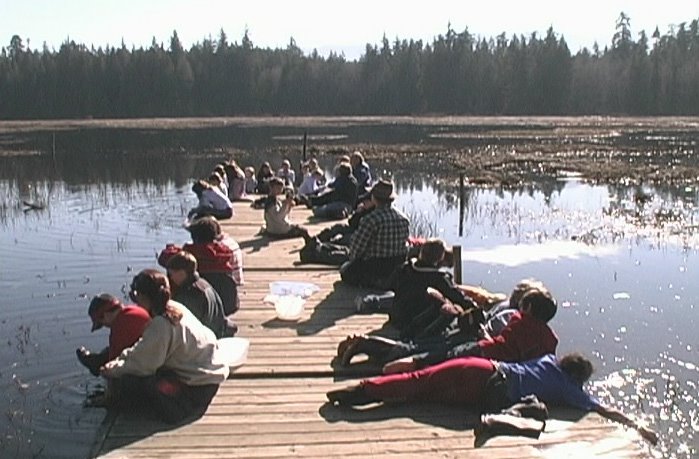
Last week I had the honour of accompanying the grade four/five class of French Creek Elementary School in their exploration of Hamilton Marsh. My last article had sparked a discussion that led to a field trip and I was asked to join them to provide some commentary. The energy and curiosity of more than thirty children wandering through the wetland forest reminded me of my own school field trip along that same trail some twenty-five years ago. I wondered how many classes have explored this unique ecosystem over the years. How many of you remember those tours?

I was inspired by the thrill, joy, and enthusiasm shown by the school children as they hunted for cones from different species of trees, caught then released frogs, and gazed into the water looking for salamanders. Those children reminded me of the inquisitive nature of humanity that many adults have replaced with greed.

Ecologically significant properties around the province have been set aside by regional districts at the request of the local voting public. However, because all crown land is governed by the provincial government (subject to First Nations Treaties which still have not been negotiated or signed), those properties have been leased to local municipalities.

When the BC Liberals took power in 2001 they ordered Land and Water British Columbia to more than double the annual rate of sale by selling-off $77 million of public (Crown) lands each year to private real estate developers. Leases, held by regional districts around the province, were not renewed when their leases expired. This despite the provincial target that 12% of the landbase be set aside for parklands. On the mainland 95% of the land base is publicly owned and managed by the crown. On the east coast of Vancouver island, due to the Dunsmuir Agreement of 1885, only 5% of the land base is crown land.

LWBC is selling off public land in Oceanside. For many years local residents have been assured by the Regional District of Naniamo that Little Mountain, Morrison Creek, and land in Dashwood known as the ‘Lost Trails Wetlands’ have been protected as parks. Recently the leases on all three properties expired and were not renewed by LWBC. That is until local residents began to learn the facts.

In July 2004 Chris Walther, RPF and local resident Ed Jewer submitted a report providing a detailed analysis of the biogeoclimatic variants and aquatic habitats in the Lost Trails Wetlands. As a result LWBC was persuaded to renew a 10 year lease for a small municipal park with the RDN and has committed in principal 3 other parcels. Mr. Jewer is encouraged by this although he would like to see long term protection for these parcels and is still very concerned that there are more sensitive areas that need to be protected. " Of the 11 wetlands identified by LWBC report, only 3 wetlands have full protection, 2 others have partial." In a water assessment document provided to Mr. Jewer by LWBC it is stated that "The water absorption provided by this land likely plays a role in recharging ground water levels and supply of moderating flows to the Little Qualicum River." LWBC currently has the remaining parcels on the market for sale.

These reports, as well as one submitted by LWBC, were assessed by the Ministry of Water, Land and Air Protection. On January 27, 2005 Ecosystems Officer M. E. Henigman wrote; “As previously advised, the study area lies within the Coastal Douglas-fir, moist maritime (CDFmm) and very dry maritime, Coastal Western Hemlock (CWHxml) BEC zones, within which all forest ecosystems are red and blue listed in the province of British Columbia. As conservation mechanisms to preserve these BEC variants on private land are extremely weak, their protection on Crown land is essential if these ecosystems are to be maintained. Development of the study area, in particular logging the mid-to-older age timber classes, can be expected to accelerate the loss of these ecosystems on Vancouver Island.” This statement is quoted directly from a letter to Mark Hallam - Acting Manager, Major Projects - Strategic Initiatives Division Land and Water British Columbia Inc.

Mr. Jewer is continuing to encourage protection on the remaining Crown Parcels. The limited listing date of March 22 doesn't leave much time. For more information please contact Mr. Jewer at (752-1833) or visit WWW.LTWETLANDS.ORG

Friday, February 18, 2005

WEYERHAEUSER LOGGING AROUND HAMILTON MARSH - Will Brookfield's Timberlands continue?

Weyerhaeuser has started Timber Cruising at Hamilton Marsh by marking off the forest that they will cut down in the near future. Somehow the Regional District of Nanaimo, which put this sensitive wetland area on a priority list back in their 1995 Parks plan, has failed to protect this ecosystem. Supposedly some sort of negotiations are underway to protect something but the process is being rushed through before anything is made clear. This may seem very confusing and that’s because it is. However, the end result of all this will be the destruction of Hamilton Marsh as we know it.

For six years I was transported on a bus to school through the forest that stood between Coombs and Qualicum Beach. Many times I rode my bicycle along this windy stretch of road and enjoyed the “Sleepy Hollow’ effect created by the tall trees, swampy pools, giant ferns, and thick underbrush. On several occasions I followed the trails into Hamilton Marsh on guided tours where biologists and bird watchers pointed out many species of birds and vegetation. Since then I have continued to visit Hamilton Marsh with friends to check out this unique open water ecosystem which attracts an abundance of waterfowl. One year the ice was thick enough for locals to skate, many people showed up from Errington, Coombs, Hilliers, and Qualicum Beach. A community treat provided by nature.

Hamilton Marsh is a unique environment because it includes a large body of open water which is surrounded by a wetland forest. This marsh performs several important tasks for the surrounding region. It helps to filter, slow down, and store groundwater that flows into French Creek. In doing so it helps to regulate the flow of water into this Salmon rearing creek which supports a salmon enhancement-program as well as providing drinking water for residents downstream. During times of drought and times of flooding, this wetland helps to regulate the flow of water, acting like a sponge that is essential for the watershed around it.

Hamilton Marsh provides a habitat for a wide variety of birds, amphibians, insects, and mammals. Studies have shown that dragonflies are of particular interest due to their abundance and variety of species. Many people enjoy the trails that have been established by volunteers over the years. Members of the public are under the impression that government bodies at several levels have already protected this environmental jewel that is an important part of ‘our’ backyards. Information should be available from your RDN representative: corpsrv@rdn.bc.ca or contact the Chair of RDN Regional Parks Plan Select Committee Larry McNabb (250) 753-2792

Today, much of the wetland forest around Hamilton Marsh has been destroyed by Weyerhaeuser. A stroll down the ‘old Coombs cut-off’ reveals clear-cuts, burn piles, and devastation all around. Weyerhaeuser claims to practice sustainable logging which they call Variable Retention but what do they really care about ‘our’ backyard? Since 1999, when the Canadian company MacMillan-Bloedel was bought by the US logging giant Weyerhaeuser, thousands of workers have been laid off on Vancouver Island. I have seen logging of the most heinous destruction, thousands of acres of land have been logged and flogged for development, the export of raw logs has increased dramatically, log sorts have shut down, helicopters have poured thousands of tons of chemicals into our watersheds, and today Weyerhaeuser is attempting to sell all of its Canadian assets to Brascan. An investment company that deals primarily with real-estate, hydro-electric dams, and nuclear power plants.

On a much smaller scale I have watched two different wetland forests near my home in Errington transformed from shady wooded areas into virtual deserts after Weyerhaeuser logged these parcels of land for development purposes. Small pools, surrounded by a dense understory of ferns and lush undergrowth, held water into the autumn after even the driest summers. The moisture retained by these wetland forests helped to maintain the water table and provided life to a variety of flora and fauna. Today this same area is devoid of trees and the discharge of water during the rains becomes so intense that the soil is washed downhill, silt makes its way into the salmon rearing streams below. Under the heat of the summer sun this same land becomes cracked and the wind helps to parch the soil, turning the area into dry wasteland devoid of life.

Friday, February 04, 2005

ENGLISHMAN RIVER ESTUARY IS A WILDLIFE RESERVE - NOT FOR PROFIT OF FEW

Is nothing sacred? When is a wildlife reserve truly protected and for how long? Locals worked hard for many years to protect the Englishman River estuary for the good of birds and other wildlife that depend upon that wetland. In 1993, through the Pacific Estuary Conservation Program, the Parksville-Qualicum Beach Wildlife Management Area was established. This victory was a direct result of local citizens who cared, lobbied, rallied, camped out, protested, and persevered.

First Nations once prospered along this coast and centered much of their lives around river estuaries including the Englishman River estuary. In the 1870’s Europeans came to the area and began to farm the Parksville flats and altered the natural flow of water with dikes. They were reminded of the true forces of nature in 1918 when the highest tides of Spring met with seasonal flood waters of the Englishman River. 150 head of cattle were washed out into the Georgia Strait never to be seen again.

In the early 1970’s a stone dike was built, without the approval of the Ministry of Oceans and Fisheries, along the Englishman River to hold back flood waters from washing over privately owned land. Several development proposals followed including a golf course, condominiums, and a RV resort that would encompass the entire area known as the Parksville flats. From the 1980’s on people worked hard to bring on board government and private agencies, raising almost three million dollars to buy out developers, in order to create a wildlife reserve on the Parksville flats.

The first action taken by Nature’s Trust, a not-for-profit organization which manages the Englishman River Estuary on behalf of all those who worked towards its protection, was to return the wetlands to tidal circulation. This included breaking the dike and removing a bridge over the renewed tidal channel that separates the Wildlife Reserve from the Surfside RV Resort and the Community Park. Tidal flow has returned to the flats and a buffer has been established between wildlife and a dense concentration of people. A delicate balance has been established to protect habitat for everyone.

In December of 2001, as a member of the Arrowsmith Ecological Association, I attended a meeting, which was closed to the public, where Glen Jamieson made a power point presentation of his proposed interpretive centre on the Parksville flats. Representatives from Nature’s Trust, Federal Ministry for the Environment, Ministry of Oceans and Fisheries, BC Ministry for Water, Land, and Air Protection, Arrowsmith Watershed Coalition, and Canadian Wildlife Service listened to yet another proposal to develop the wetlands.

Many of those present expressed a great deal of concern about bringing thousands of human visitors to a sensitive estuary ecosystem reserved as habitat for birds and other wildlife. Jamieson finally admitted that his plans involved building a bridge over the same tidal channel where Nature’s Trust removed a bridge in order to protect the wildlife reserve from the direct and negative impact of tens of thousands of people.

Surfside RV Resort has a lot to gain with a bridge, which would effectively expand their backyard. Surfside has already altered the nature of the estuary with a massive stone causeway along the beach and mudflats. Crowds of people from the community park would gain easy access to the wildlife reserve. How would this affect wildlife?

All of the organizations who opposed Jamieson’s plans at that initial presentation were noticeably absent from recent negotiations. They must be consulted before continuing with development plans because they can provide insight into the well-being of this wildlife reserve. If you have an opinion please contact Parksville Mayor Randy Longmuir 954-4661or e-mail: citypark@city.parksville.bc.ca

Millions of migratory birds stop in the Englishman River Estuary to feed alongside several species of resident birds such as King Fisher and Eagle. Many birds nest in this lush, sensitive, and very limited ecosystem. All of these wildlife activities are made possible because this area is protected, primarily from human activities.

Birders from around the world make Oceanside a destination to bird watch and photograph wildlife in this picturesque environment, notably during the Brant Festival. They spend money locally but are here for the birds. The concept of an interpretive centre to educate the public about the sensitivity of endangered ecosystems and the wildlife they support is honourable, but cannot come at the expense of the very ecosystem we hope to preserve. The birds? I think they just want to be left alone.

Friday, January 21, 2005

TONIGHT I LOST AN OLD FRIEND

While working on my computer in front of the large picture windows in my cabin, I heard a loud crack. Thinking that a branch, high above me in a fir tree, had broken off under the weight of snow I ran to the doorway in case the windows were smashed by the falling branch. A crash followed by a thud confirmed my suspicion but the cabin had not been struck. I shone a flashlight through the front windows and could only see what appeared to be a large chunk of wood laying outside in the snow. We have had about 16 inches of snow fall and stick here in the past few days which is very unusual for our climate.

Later, when I went outside to investigate I saw that the top 60 feet of a 100 feet tall old growth Douglas fir tree had snapped off and was now lying in the snow in front of my cabin.

12 feet in circumference, this tree survived the forest fire of 1885, living to the age of approximately 500 years which is about half of the life expectancy for this species. Many years ago this tree had suffered a lightning strike leaving it with a rotten top composed of several giant limbs. The rest of the upper branches were healthy and grew to be very thick but deformed by the stunted crown. The trunk showed significant conks from a laminated form of fungi, which probably saved if from logging that took most of the other trees in the area. Now only a trunk of about 40 feet is left standing.

My parents and I moved to this property in April 1975 and I have always admired the largest tree for its thick wrinkly bark, shape, and strength. At that time this tree towered over the forest, a giant compared to all other trees in both height and girth. This tree seeded many of the surrounding trees which have grown to be taller than their parent. I have made many discoveries from this tree and have been inspired to investigate the history of forests by its presence.

I have seen many birds spend time on this magnificent wildlife tree including: Pileated Woodpecker, Northern Flicker, Red-Breasted Sapsucker, Hairy Woodpecker, Downy Woodpecker, Winter Wren, Mountain Chickadee, Chestnut-backed Chickadee, Cooper’s Hawk, American Robin, Spotted Towhee, Varied Thrush, Dark-eyed Junco, American Kestrel, Red-Breasted Nuthatch, Brown Creeper, Stellar’s Jay, Pine Siskin, European Starling, Crow, Raven, Bald Eagle, and even a Great Blue Heron landed in it to make some outrageously loud squawking. I watched a female Rufous Hummingbird gather cobwebs woven across the deep cracks in the bark, to use in constructing a nest. One night I listened to a pair of Barred Owls call each other from distant trees, slowly moving closer to each other. They met in the Old Douglas Fir tree in front of my cabin where they began to make noises that I had never heard them make before or since. That was the first year that those owls nested nearby and brought 3 fledgling into this world.

I witnessed the death of a friend tonight, a friend that stood before Europeans came to conquer this continent. I will miss this beautiful tree but it will be decaying for hundreds of years providing life for a multitude of insects, plants, and other trees. Birds will continue to benefit from this fallen giant and the colossal snag that still remains, standing firm. Its carcass will hold moisture during the dry season, providing habitat for amphibians and germinating seeds. We will leave the broken piece to rot where is lies and watch the standing truck decay naturally over time. The cycle continues, the succession of the forest.

In his letter to the Editor “Protection is ongoing” (The News Jan. 14) WLAP Minister BIll Barisoff compares this natural process of the forest to the ravages of clear-cut logging left by industrial corporate giants. A stump field is being offered as a park while a primeval Douglas Fir forest with trees that are hundreds of years old, evolved over millenniums will be logged by Weyerhaeuser in the Cameron Valley. I would like to see Cathedral Grove Park expanded to include all old growth trees in the Cameron Valley but somehow the BC Liberals put politics and greed ahead of the protection of the environment.

Friday, January 07, 2005

ENVIRONMENTALIST HONOURED AROUND THE WORLD - WE CAN MAKE A DIFFERENCE

The Nobel Peace Prize for 2004 was awarded to Wangari Maathai of Kenya for leading a powerful crusade against deforestation. As an environmentalist and women’s rights activist she led the “Green Belt Movement”, which mobilized women to plant 30 million trees in a country where 98 percent of the forests have been logged or burned. The Nobel committee said. “Peace on earth depends on our ability to secure our living environment.”

Dr. Maathai was jailed, beaten, and persecuted for working to stop deforestation in Kenya. She spoke out against the destruction of the natural environment and challenged both the status quo and the government for not protecting the forests that provided life for millions of people. She motivated tens of thousands of woman to change farming practices and managed to persevere against many obstacles. She is now the Deputy Environment Minister of Kenya.

In British Columbia government, big business, developers, and special interest groups are constantly working together to discredit environmentalists. Millions of tax payer dollars and private corporation profits are spent each year to convince the public that we can continue to destroy the environment with little or no consequences.

As a documentary film-maker I have been in enough ministers’ offices, executive boardrooms, and community halls to know a smoke-screen when I see one. The BC Liberals are about to announce just such a red-herring in the hope that the public will re-elect them in May. Logging in Cathedral Grove will continue as usual but the ‘PR spin’ will lead you, the tax payers, to believe that forest land is to be protected while paying off Weyerhaeuser with cash and/or a land swap.

What is actually happening is that the public will be buying approximately 140 hectares of land in the Cameron Valley from Weyerhaeuser. The majority of this land has already been logged and is currently a monoculture tree farm with Douglas fir trees that resemble christmas trees.

Weyerhaeuser could not log the tiny trees in this area for a long time so why pay taxes on land that is not turning over a profit today when they can trade it for land that they can log right away? Meanwhile the only land outside of the present day park that has a substantial stand of old growth trees is excluded from this latest secret deal.

Vice President of Weyerhaeuser Canada Craig Neeser said; "Make no doubt about it we are going to log Cathedral Grove!” This may seem hard to believe, but then again most people think that H.R. MacMillan ‘gave’ Cathedral Grove to the people of BC.

The reality is that in 1952 MacMillan swapped 136 hectares of forest in the Cameron Valley for logging rights in Strathcona Park. The oldest provincial park in British Columbia has been cut up, divided, logged, mined, dammed, and swapped by provincial governments since it was ‘protected’ in 1911 by a special Act of the Provincial Legislature.

The Supreme Court of Canada recently ruled that the BC government must insure that industry does not degrade land that is claimed by First Nations in ongoing treaty negotiations. The Supreme court of British Columbia turned down the BC Liberal’s application for an injunction to remove the public from the proposed parking lot site in the Cameron Valley.

In 1885 the public began to lobby the government for a park to protect “Cathedral Grove” from the peak of Mt. Arrowsmith to Mt. Horne including the Cameron Valley and Cameron Lake. Today concerned citizen have been camped in Cathedral Grove for 10 months with this same demand. Don't let public opinon be side stepped by WLAP Minister E-mail: Bill.Barisoff@gems6.gov.bc.ca When will BC get a Minister for the Environment who respects the earth for what it is: the provider of all life?