Friday, May 09, 2008

DRAINING THE LOCAL WATERSHEDS

The Pacific tree frogs are singing in the wetlands, after a long winter of hibernation in the mud. Their eggs laid, in balls of transparent gel attached to twigs or grass stems, these tiny amphibians will climb into the trees and spend the summer eating insects.

Rough-skinned newts, commonly mistaken for Salamanders with orange bellies, can be seen crawling slowing from their nests under logs towards pools of still water. They will mate and then the females will lay individual eggs on the leaves of submerged vegetation. The hatched larvae take 4-5 months to reach maturity and rely on standing water for survival. The adult will stay in water for as long as possible and then move to the damp shade under logs and rocks.

The natural drainage of the Oceanside region, for that matter much of the east coast of Vancouver Island, is such that water was retained in wetlands. Although it rains a great deal during the fall, winter, and spring months the summers are usually dry. These annual extremes between flood and drought demand that water be held back for several months in order for life to prosper.

Wetlands by definition retain water throughout the year, several types are found in this area including: Marsh, Fens, and Woodland Swamps. Marsh areas have an abundance of grass and other vegetation along with open water, which combine with peat moss to act as a sponge that maintains water levels throughout the year. Hamilton Marsh is the only local wetland that qualifies for this distinction and it is owned by Island Timberlands who plan to log the forest around it and develop the land for real estate.

Fens, or peat-forming wetlands, can be found at a variety of locations from the lowlands up into the sub-alpine. The ridge overlooking Oceanside is currently covered with large patches of white snow. Those are clear-cuts: the result of logging in the past few years where there were once an abundance of fens.

By far the most abundant wetland type, in this area, are forest swamps. Historically, surface water has been retained in low spots under the shade of trees where thick sword ferns cover the moist soil, even during a prolonged draught. Many landowners drain these areas to allow for development. The run-off is then accelerated during the rainy season leaving very little or no moisture in the summer, particularly if the wetland in covered with backfill.

Currently many government agencies have limited jurisdiction over water but none of them have the clout to make private and corporate landowners comply in order for local drinking water to be protected.

The BC Ministry of Environment and Minister Responsible for Water Stewardship and Sustainable Communities has not enacted any legislation with regards to water. However they have named their water action plan: “Water for B.C. — Safe, Sustainable, and Valued by All” According to Minister Barry Penner’s website: “The plan is built around three broad goals: public health and safety, healthy watersheds and responsible use, and encourages British Columbians to adopt a sustainability ethic around caring for and protecting water resources and aquatic ecosystems.”

No mention of corporate responsibility, although big business uses by far the largest amounts of water in this province to flush mines, cool pulp mills, drill for oil, and cool metal smelting plants. Oceanside has 7 golf courses, with several currently under construction. Each 18-holes uses more than 1 million liters of water every summer’s night. Logging corporations, like Island Timberlands continue logging the ‘aquatic ecosystems’ such as the banks of Hamilton Creek as seen on Highway 4A between the town of Qualicum Beach and Coombs.

The BC Ministry of Health can intervene in the case of extreme situations. The Regional District of Nanaimo has very limited authority over water. The Federal Department of Fisheries and Oceans prescribes 30-meter setback from Rivers and Creeks but does not enforce these limitations on private lands.

Ironically, the BC Ministry of Transportation has the most control over the flow of local surface water. Ditches have been dug along every roadway to drain surface water. The goal of this Ministry is to discharge the water to the ocean as rapidly as possible. This in direct contradiction to nature, which seeks to retain the water for the dry season so that life can exist during the summer droughts.

Monday, April 14, 2008

AGRICULTURAL LAND RESERVE UNDER ATTACK - ONLY CONSUMERS CAN SAVE ALR

HARVEST MOON RISES OUT OF THE COASTAL MOUNTAINS - ACROSS THE STRAIT OF GEORGIA FROM VANCOUVER ISLAND

In days gone by Grafton Avenue ran through orchards and field of berries. Royalty in England ate jam from Errington on their scones and crumpets with afternoon tea. During the early part of the twentieth century Vancouver Island farms produced 85 percent of the food that was consumed locally.

Over time the petroleum industry has dominated the food industry by providing increased transportation networks as well as cheap chemical fertilizers. So then suppliers could ship produce around the world and monopolize on cheap labour forces in other regions. Limitations of weather dictated by the seasons could be overcome by ordering produce from thousands of kilometers away, even from the other side of the equator. Consumers began to depend upon these supplies and the low prices with little thought for the cost to the planet.

In other countries pesticides, herbicides, fertilizers, genetic modification, can be used with little or no regard for standards or regulations in place where the consumer is buying the produce. People working the fields, preparing the food, and packaging it for transportation are faced with extremely low wages, dangerous work conditions, and long work weeks.

The Brazilian rainforest is being cut down and burned to make way for Soya beans, beef cattle, or corn to produce bio-diesel. The soil is so poor that it has to be abandoned after a year or two and the process is repeated. The lush jungle of the rainforest will take tens of thousands of years to grow back. The produce is then shipping around the globe to provide consumers with cheap food or fuel.

Located around lakes and rivers that can provide water for cultivation, low valley bottoms and estuary deltas have provided humanity with fertile soil to grow the majority of food needed for the growth of civilization. Populations grow with the abundance of food and increasingly demand more land to build houses and commercial structures. This balance between farmland and development has been going on for as long as civilizations have conquered the natural world.

Today some people in British Columbia, and in particular around Oceanside, want to remove land from the Agricultural Land Reserve in order to subdivide their land for housing development, building golf courses, and industry. Their claim is that the land is standing fallow so it should be put to use.

The fact is that the land can bring in more immediate cash today with a heightened real-estate market than if could in the short term as a hay field or low yielding farm. For the most part farming has become a losing proposition locally since it is extremely hard to complete with the global market controlled by multinational corporations.

On April 18, 1973 BC’s Land Commission Act came into effect. The Provincial government appointed a new Commission, to establish a special land use zone to protect agricultural land. The "Agricultural Land Reserve" was established in collaboration with local governments and protected 5% of BC, which was the most critical to the province’s food production. The ALR was very popular for many years because the public saw that development was slowed and farms were being protected.

Today Vancouver Island is almost completely dependant on the rest of the world for food. Try going to any grocery store locally and find an item that was produced on Vancouver Island. If you find one buy the item and tell your friends. A few local markets during the summer provide local farmers with the opportunity to sell their produces.

Cormie’s farm on the south side of Parksville has been growing and selling produce grown either on their own land or by mostly local farmers for over thirty years. There are other examples of local success including Little Qualicum Cheese Factory, Blueberry Fields Farm in Coombs, and the Coombs Country Market with a few local items including the goats on the roof.

Consumers are the only ones who can change this trend by demanding that local farmers be represented in local stores. Paying more for local produce makes sense when you factor in the costs to the plant.

Please let your Mayor and Council, MLA, and Regional Director know how you feel about allowing Agricultural Land to be developed locally.

Friday, April 04, 2008

MANAGING WATERSHEDS

LOGGING ALONG RIVER BANKS CAUSES EROSION WHICH RESULTS IN SILT PLUGGING UP THE WATER

Walking down by the ‘Clay Banks’ along Englishman River I look up at the bottom of the steep bank that has been eroding into the water for as long as I can remember. Today, just a few spindly trees, teetering on the edge of the vertical drop, roots dangling in the air, top this massive clay monument. Half way down the 40 meter bank is the latest casualty, balanced at a strange angle, rootball exposed to the elements, waiting for the next heavy rains to dissolve the clay before this tree slides down into the river.

Over the last few years TimberWest has logged a massive clear-cut to the edge of this sheer drop-off. Island Timberlands has also been using feller bunchers to cut down the fifty year old tree farm that runs along Englishman River. The forest lands on the south side of the river are privately owned and therefore the BC Ministry of Forests claims no responsibility for ‘forest management’ and the BC Ministry of Environment leaves it up to the companies to do the right thing.

The Federal Department of Fisheries and Oceans does have jurisdiction along the river corridor and has considerable clout to prevent damage to the river. However, as is the case with many other rivers like it across the province, the DFO have approved this logging on the banks of Englishman River.

Directly across the river, is a large salmon enhancement project. Water has been diverted from the natural flow of the river, into man made channels that have been designed for rearing salmon. Local First Nations, Fisheries and Oceans Canada, Pacific Salmon Foundation, BC Ministry of Environment, Human Resources Development Canada, Stream keepers, The Nature Trust of BC, and other agencies have all been involved in this ongoing project.

Salmon returns have increased but nothing like those prior to the 1980s when multi-national logging companies began to clear-cut 2nd growth forests/tree farms on privately owned land along the river. Englishman River continues to be listed as one of the most endangered rivers in British Columbia, due to logging and real estate development.

When Weyerhaeuser bought out MacMillan Bloedel in the late 1990s it took the Chief Forester of BC’s recommendation that the rotation of a tree farm be 80 years between harvesting, and cut it in half. 40 years is now the standard rotation time for logging on Vancouver Island by all the logging companies. Much of this land can be logged with feller-bunchers, which means that very few people are employed while vast tracts of land can be clear-cut in a very short time. Island Timberlands, TimberWest, and Western Forest Products own the majority of private land on Vancouver Island.

Many questions arise when managing land: Is the land privately owned, managed by the crown on behalf of the public, and have first nations been consulted? What are the most important values for this land? Should we see the land as forestry, watershed, recreational park, Jurisdiction is key, since much of the time several agencies are responsible and they do not always consult with each other, and plan management together.

Stream Keepers are planting trees to fill in gaps in the forest made by excavators as part of the Englishman River Watershed Recovery Plan. Over the past few years large logs (referred to as large woody debris) have been placed along the river and tied to trees and/or piles of blasted rock with steel cable. The hope is that these log jams will slow the flow of water and create pools, which will provide habitat for fish fry. In the process excavators removed trees and the under-story of brush in order to access the riverbanks. A few months after Stream Keeper volunteers had done their planting, at one site along the bank, excavators returned and crushed all of these seedlings.

Managing nature has been left up to government and private industry for many years in British Columbia. Each election changes the priorities and most initiatives are undertaken on a project-by-project basis. Many different agencies, working on their priorities, overlook the bigger picture in order to complete specific tasks. As a result complimentary projects are not united, and often one project fundamentally undermines another.

Friday, March 21, 2008

ALTERING NATURE FOR PARKS

WHEN A TREE IS FELLED IN A PARK IS IT ANY DIFFERENT FROM A TREE FELLED IN THE FOREST?

Using dynamite to blast the trunks of trees into smithereens may make falling a 600-year-old Douglas fir safer for the humans doing the work. That’s is the contention of the workers compensation board with regards to the contractors working for BC Parks and the Ministry of Environment in Cathedral Grove. According to media reports there are 9 danger trees that must be felled in order to make it safe for tourists to walk on the paths in the Provincial Park.

Spring is here, birds are nesting, Elk are in the valley with calves, and small animals are giving birth to their young. A tour of the area, with parks manager Dave Foreman and several key participants in the falling, revealed that more like 40-50 old growth trees would be blasted along paths, the highway corridor, and anywhere BC Parks identified as a threat. There will be no straight cuts left by chainsaws so the counting will be difficult.

Parks have always been designed by human beings for humans, and when their needs change so do the parameters of the parks. However there is a point where parks are altered by humans to the point that they no longer reflect the nature that they were designed to preserve.

Strathcona Park, the first and oldest BC Provincial Park established in 1911, has been dissected and compromised over the last century. Logging, highways, and mining have been allowed to alter the integrity of this park. Portions of the initial parkland have been pulled out of the protected area by government and sold or traded to logging companies.

Parks can also play a key role in rehabilitating a compromised ecosystem while providing recreational and educational opportunities for the public. A prime example locally is the Englishman River Regional Park, which runs upstream from Top Bridge to Morrison Creek. Officially opened to the public last fall by the Regional District of Nanaimo, the Nature Trust of British Columbia, and several other partners this park includes second and third growth trees ranging in age from freshly planted to approximately 50 years old depending on the age of the cut block. The park compliments the Salmon Enhancement Project, Englishman River Watershed Recovery Plan, and several other rehabilitation projects along the Englishman River. This park combines public needs with restoration presenting many opportunities through stream keepers and other groups that help to educate the public.

The needs of people and nature are interwoven and continue to be linked but society tends to try managing nature in order to tame it. Controlling nature may seem like a practical solution to societies fear of the wild but managing parks for people tends to compromise nature to the point that is destroyed. The BC Parks Act makes no bones about the fact that most parks, with the exception of certain components of a class “A” park, have been set aside for the public to use for recreational purposes.

Carmanah Provincial park, directly across the Island from Oceanside due south on the west coast, was protected in 1989 and the lower Walbran Valley was added in 1991. The public demanded this protection to save some of the last ancient temperate rainforest as well as to establish a reserve for the Marbled Murrelet to nest.

Logging has continued all around the Carmanah/Walbran park and today the clear-cuts run directly along the boundaries. All access to the park is on industrial logging roads and when the trees licensed for logging are gone from the companies that built these roads will have no reason to maintain them. In fact, 2 years ago TimberWest threatened to remove a key bridge so they could move it to another location. Already, the roads entering the park are in such bad shape that it discourages the public from visiting. With fewer and fewer visitors the government is already beginning to grumble that the primary purpose for a park is to provide the public with recreational opportunities. Industry has already built the roads in and would like to continue logging. Where is this leading? No people in the parks, unused timber just standing there rotting, roads in place, need for economic stability in a declining forest industry…

Saturday, March 08, 2008

BUILDING GREEN IS THE WAY TO GO

This week I took a journey into unknown territory, in an environment that kept me out of the sun. I spent two days listening to architects, construction engineers, designers, municipal planners, authors of building codes, certification administrators, energy consultants, and building contractors of every discipline. I learned a great deal as one of 400 participants in the ‘Building Green in a Changing Climate’ conference and trade show held in Courtenay.

Public demand for environmental standards and accountability has sparked change in the construction industry and some companies are complying with tough standards in order to attract customers. Rising material costs, as well as an increase in operational costs for all buildings, have combined with skyrocketing energy costs. The result is that the construction industry is beginning to realize that it must seek out alternatives. In today’s market place building ‘green’ makes sense economically.

A great deal of creative and technical innovation is being generated with amazing results that will effectively revolutionize the building industry. However, only a small percentage of industrial, institutional, or residential construction projects are currently being built using green thinking and materials. The ground swell has begun and now it is up to the public to move it forward so that industry follows through with this green trend.

Leadership in Energy and Environmental Design is a market driven system, which is attempting to prove to consumers that building construction meets with the highest environmental standards. LEED is an internationally recognized rating system that encourages the construction of green buildings, administered by the Canada Green Building Council. Accredited professionals are trained and certified to monitor projects in order to award buildings with coveted ratings.

LEED has 5 principle categories by which it assesses construction projects for environmental sensitivity: Sustainable Sites, Water Efficiency, Energy and Atmosphere, Materials and Resources, Indoor Environmental Quality. Certification is based on the number of points awarded for their compliance with these standards. Innovation in the design process can win additional points and negative points from noncompliant areas can be off set by points gained in other areas of the overall project.

One contractor admitted that they separated all of the construction waste material, went to great lengths and expense to transport it to the proper facility, and then discovered that it was all dumped into the same land fill. None of the material was recycled because the governing authorities had not implement any recycling at that facility. However, the building received LEED points based on the fact that the contractors had done their part to recycle the material. Other large projects reached targets of 95% recycling of waste materials where the proper facilities were available in larger urban centers.

In today’s real-estate market on Vancouver Island, with the potential for massive returns on investment dollars, entire communities are being built from scratch. The theory is that environmental devastation, caused by bulldozing large tracts of land, can be off-set by the ability to plan an entire town based on platinum rated ‘green’ standards. On paper it may work to move environmental points from one area to another, but on the ground when the road is blasted in and the trees are cut down the ecosystem is changed forever.

The term ‘Net-Zero’ refers to the energy consumption of a building, this along with ‘carbon neutral’ were catch phrases used repeatedly throughout the conference. In the forefront of my mine was the term “Green wash!” However, I truly believe that many of the professionals who made presentations at ‘Building Green’ want to change construction and are working towards a green future.

A strong argument was presented about sustainable building practices, since current construction practices tend to produce homes which may only last 30 to 40 years. European models have proven that residential buildings can exist for hundreds of years by using the proper care and attention to design, construction, and materials. The call was for building standards that will increase the longevity of buildings so that they are accountable to the amount of energy and resources put into them, thereby effecting environmental sustainability.

Thursday, February 14, 2008

BC LIBERALS & POLICE PAVE WAY FOR DEVELOPERS AT SPAET MOUNTAIN

Wednesday February 13 morning, before first light 70 police officers arrested 7 people dedicated to protecting the Langford Cave and Garry Oak ecosystem near Goldstream park. Swat teams stormed over the forest arresting 2 tree-sitters and 5 others at gunpoint (many shotguns, hands guns, and rifles) A great deal of force was used, although no charges were laid and it appeared difficult to find a judge who would go along with this police action.

Last week I was giving a tour of the area to a TV crew from France when 2 RCMP officers approached me for my name. I reminded them of the Charter of Rights and Freedoms that entitles every citizen in Canada to privacy, association, and freedom of the press.

I began to talk with one officer about the Gary Oak Ecosystem that was going to be destroyed by the planned highway interchange. He didn’t think it was a problem and then related his own personal story. He wanted to build a second garage beside his home and found the local bylaws prevented him from simply cutting down 2 massive Garry Oak trees in his backyard. He was forced to hire an accredited arborist who wrote a letter stating the trees had to go before the garage could be built. Then he had to acquire a permit to remove the trees which was only issued after he provided a receipt for 2 replacement Garry Oak trees over 6 feet tall. He was obviously upset that he couldn’t simply destroy the ecosystem that was in his way but the result was the same. No more ancient Garry Oaks in his backyard, just young seedlings.

Garry Oak Ecosystems are endangered according to the BC Ministry of Environment, who state: “Restricted to southwestern British Columbia, these ecosystems are among the rarest in the province.” They contain a diverse array of animal and plant life, including Northern Alligator Lizards, Easter Lilies, Camas, and Shooting Stars. This unique grouping of species only occurs within the Coastal Douglas-fir Zone on south eastern Vancouver Island and some of the gulf islands. Over 97% of the Garry Oak ecosystems have been destroyed by development.

Oceanside’s Nanoose notch is a rare example of an intact hillside, however a walk along those bluffs will reveal development on all sides where the rocky outcroppings are being bulldozed. Hopefully Fairwinds and the Department of National Defense will be encouraged to protect this rare ecosystem.

First Nations named the mountain SPAET, long before wealthy athletes dubbed it Bear Mountain, and it played a significant part in their culture. Garry Oak flourished on this mountain providing important medicine and food plants such as camas. Several sacred caves are concealed below SPAET; tiny entrances open up into massive chambers hidden below the surface. Vancouver Island has many hidden caves, due to a phenomenon known as Karst, whereby rainwater seeps though the hard rocky topography wearing away the softer limestone.

When First Nations tried to protect one of these caves they met with strong residence by Bear Mountain developers who filled it in with tires, debris, and rock before collapsing it with dynamite. Police and government downplayed the situation and the courts approved an injunction to prevent key First Nations from visiting Bear Mountain property.

Between 1998 and 2001 the BC Land Reserve Commission rejected several attempts by Western Forest Products to transfer crown land from the tree farm license on Skirt Mountain to private ownership.

The BC Liberal party came to power May 2001; 2 months later BC granted 44 hectares of Crown land on Skirt Mountain to Western Forest Products for $1.05 million. This land is adjacent to Goldstream Provincial Park. 6 months later the Land Reserve Commission allowed several hundred hectares to be taken out of the Forest Land Reserve, which WFP sold for $7.5 million to private developers. A few months later the District of Langford re-zones this property allowing large-scale development.

Between 2002 and the present, the Bear Mountain Parkway was built through the former Forest Land Reserve lands. An 18-hole golf course was built on the former Crown lands and WFP lands, along with a village-centre of shops, condominiums, an hockey arena, and a high-rise Westin hotel. Several hundred luxury homes were built on terra-formed platforms, formed by blasting the mountain in long troughs and then leveling the rubble into flat pads, where Garry Oak and Arbutus meadows once stood.

-30-

Thursday, January 17, 2008

BC LIBERAL LAND GIFTS EFFECT US ALL


Growing up in Errington, my neighbour across the road was a grumpy old man who lived with his wife in a doublewide mobile home. He was the only person in the area who posted a Social Credit sign at the front of his driveway during every provincial election.

From 1952 to 1956 Robert Sommers was Forests Minister of British Columbia. On his watch, and with the persistence of Commissioner Gordon Sloan who investigated the logging industry, the Tree Farm License system was established. The basic concept was that large tracts of publicly owned land would be divided and managed by the Ministry of Forests. Each TFL would assure a timber supply for a particular logging company. In exchange the company would have to provide mills, jobs, and stumpage fees. The TFLs were tied to the communities and were supposed to provide sustainable logging and economic security in perpetuity for future generations.

In 1958 Robert Sommers was convicted of bribery and conspiracy. He went to prison. Premier W.A.C. Bennett and his Social Credit government were able to dodge accusations that they were involved in the selling of large tracts of publicly owned land sold to individuals and corporations. These sales were made before the lands were put up for public action, as required by provincial laws. Bob learned to tune pianos in prison. The land sales were final. Some people got rich. Forests were clear-cut as far as the eyes could see. The forestry industry boomed for many years.

Then the Youbou Mill was shut down after 73 years. 200 people lost their jobs along with approximately 400 people who lived by those people. The village of Youbou, on the shores of Cowichan Lake, was devastated. Clause 7 of the BC government’s timber agreement with TimberWest legally tied the TFL to the community. The Ministry of Forests waved that clause in 2001, allowing TimberWest to shut down the Youbou Mill and export raw logs from that TFL.

In 2002 the BC Liberals allowed 3.7 million cubic meters of raw log to be exported, this was the highest amount on record and translates to 100,000 full truckloads. According to the Youbou Timberless Society (www.savebcjobs.com) these exported logs would be enough to employ almost 4000 people and run 6 sawmills for a year.

Since then many more mills have been shut down around the province. The BC Liberals have been taking apart the TFL system and giving crown land to private corporations. The Supreme Court of Canada has ruled that First Nations must be consulted before any land is changed from crown to private, but to date the BC Liberals have not complied with these rulings.

Logging companies have obviously realized that their methods are not sustainable even after reducing the harvest rotations from 80 years, as recommended by the Chief Forester of BC, to 40 years. TimberWest, Western Forest Products, and Island Timberlands (Brookfield Asset Management) have all become land developers on a grand scale.

Honourable Rich Coleman is the Minister of Forests and Range and Minister Responsible for Housing. According to the ministry’s website: “Before his election to the Legislative Assembly, Mr. Coleman ran a real estate management and consulting company.”

His older brother, Stan Coleman, works for Western Forest Products where he is their Manager of Strategic Planning. In 2007 the BC Liberals pulled 28,273 hectares of land, just west of Sooke, from a TFL and gave it to Western Forest Products without any financial compensation.

In June 2005 Stan Coleman was working for Cascadia Forest Products when private land was removed from TFL 44, near Port Alberni. Rich Coleman was appointed as Minister of Forests in June 2005. Today, this newly privatized land is owned by Brookfield Assets Management Inc. through its subsidiary Island Timberlands.

The Auditor General of BC is conducting an inquiry into the lands pulled out of the TFLs and given to private corporations. He needs your encouragement to put a stop to this blatant corruption. John Doyle Auditor General of BC 8 Bastion Square Victoria, BC V8V 1X4 Tel: (250) 387-6803 Fax: (250) 387-1230 comments@bcauditor.com

Friday, January 04, 2008

WATER AND FORESTS SHARE SYMBIOTIC RELATIONSHIP


I was soaked by blasts of mist blown into my face by the intense pounding of water on rock at Englishman River Falls during the last high water event. The relatively narrow cleft in the rock, carved out by the constant onslaught of water, funnels the river down into a deep canyon worn over the course of centuries.

A swirl of mist sprayed into the air with a chaotic pulsating rhythm. The moisture either dropped back into the foaming rage of the waterfall or became airborne and drifted high up into the canopy of the forest.

Heavy rains combined with the rapid melting of a recent snowfall combined to swell the river to the point that it spilled over its regular banks at several places along the length of the river. A thick mat of tree and shrub roots covering the forest floor, help slow the flow of water during heavy rains and retain moisture during the dry seasons. This dual function allows the forest to survive through all the seasons of the year and prevents massive erosion during extreme weather.

I remember watching the miracle of clouds being created by the ancient rainforest in the Walbran Valley. It was late spring, heavy rains had been pouring down for several days, when the weather broke into a beautiful clear sunny day, which warmed the air and my bones.

From my perch on a massive cedar stump in a clear-cut provided by TimberWest, I had a perfect vantage point of the entire low valley bottom forest surrounding Anderson Lake. The ancient rainforest is intact for several kilometers between the clear-cuts of TimberWest, on the south side of the valley, and Weyerhaeuser on the north.

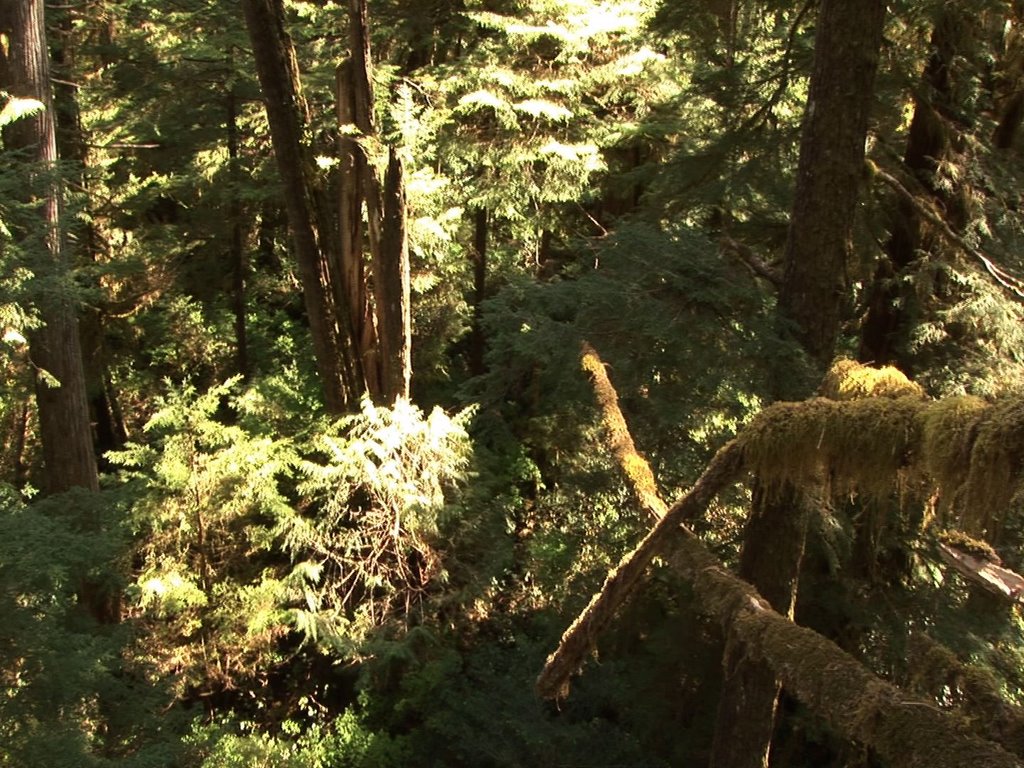
Unlike a second growth tree farm, the canopy of this primeval forest is far from uniform. Much of the forest is made up of a mixture of Western Pacific Hemlock, Balsam Fir, with a few thousand-year-old yew trees as well as a smattering of deciduous trees along the river. In the foreground I could see thousands of old growth Pacific Red Cedar trees, with their broken crowns and bare wood exposed, poking out of the canopy.

Many of these Cedars have been recorded as being over 1000 years old with a few veterans noted at over 1800 years old. In the distance I could see the towering trunks of Sitka Spruce, dwarfing the other tree species by reaching to nearly double their height. A stand of these massive Sitka, registered as being between 700-900 years old, grows in the fertile soil along Walbran Creek.

I could see everything with perfect clarity through the clear air when I first sat down. Then slowly I began to perceive a slight haze forming over the treetops. I watched a humming bird work the salmon berry bushes below me for the pure sweet nectar of their pink flowers for a while, when I looked up the haze had turns into a soft mist.

Slowly, wisps of mist drifted between the treetops and began to form swirls of delicate clouds. Small pockets of dense fog were forming all across the valley, and some of them were blending into each other. Soon the tops of the giant Sitka Spruce were obscured completely by the rising fog.

Then things began to change rapidly. A blanket of thick fog formed over the entire valley and soon I could not see any of the trees below. In a few hours the entire valley, several square kilometers, was socked in by dense fog, reaching from one mountain ridge to another.

The forest had pumped the moisture from the ground back into the atmosphere. The roots had sucked up a large volume of water, dumped by rain clouds blown in from the Pacific Ocean. The water was then pumped up through hundreds of thousands of trunks to the needles of the predominately coniferous forest and released into the atmosphere with the help of the sun. The resulting bank of fog remained in the Walbran Valley until the next day when an off shore wind picked up and blew the massive cloud into the next valley and beyond.

Thursday, December 20, 2007

HARPER BRINGS SHAME TO CANADA

This year the winter solstice brings ill tidings to us northern folk. Canada was seen by the world as one of worst adversaries of environmental change.

At the Bali Climate Change Summit nations met to work towards a new global treaty, which would include setting carbon emissions for rich countries. Canada teamed up with the United States to block the consensus reached by all the other countries present at the global summit. Then a group of countries, all of which had signed the Kyoto treaty, tried to move forward without the USA but they were blocked by Canada.

In just a few days 110,000 Canadians joined a petition to let our political leaders know that they were not acting upon the wishes of the general public at the Bali summit. Thousands phoned, faxed, wrote, and e-mailed members of the government. At the 11th hour Canada finally backed down. All countries present at the summit booed the USA. At the last minute the USA finally reversed their negative stance.

600,000 signatures from 192 countries were presented to politicians at the summit demanding they recognize that the citizens of this planet want to work towards global climate solutions. However, as a result of Canada’s negotiations, massive compromises were established at the end of the summit. Regulations for emissions and other environmental standards were lowered significantly to meet the demands of Canada and the USA.

The European nations talk big but they also, are not meeting the regulations to reduce emissions set for the world. The Bali summit has merely established that countries in attendance have agreed to the framework for a Climate Change Treaty, which will be formulated and voted upon at a later date.

At home the Harper government claimed victory at Bali and continues to talk enviro-jargon after putting up a massive fight that has compromised efforts to reduce emissions and environmental damage to the atmosphere of this planet. Meanwhile the vast majority of Canadians want to reduce the environmental footprint we are making upon this planet.

Then again, checkout the malls. How many SUVs, massive trucks, single occupancy vehicles are in the parking lots? Consumerism is the number one threat to the environment. On an individual basis we all have an obligation to reduce the amount we consume. Most products contain plastic, deprived from oil and a great deal of oil was burned to deliver most items to the consumer. How long will the individual actually use the item?

Canada chooses to extract the mostly costly source of oil on Earth, while our government blocks international efforts to reduce green house gases. Many scientists agree that this economic oil boom will become our worst nightmare by destroying the atmosphere that provides us with life.

The largest deposit of tar sands on Earth is located in the Athabasca oil sands of northeast Alberta around Fort McMurray. Tar-sand oil extraction projects do the most damage to the environment of any energy source on the planet. First massive open-pit mining is used to remove the tar, which is fused with sand. As part of the extraction process vast amounts of clean water are used in a process called Steam Assisted Gravity Drainage. The water is then discarded as polluted muck. Today in Alberta natural gas, primarily from northern British Columbia, is piped in and burned to generate electricity used to separate the oil from the sand. Plans are underway to build nuclear power plants to produce the electricity to meet the demand.

More than 80 kg of greenhouse gases are released into the atmosphere for every barrel of synthetic oil produced in Alberta, each refined barrel of oil weighs 130 kg. Gasoline refined from tar sand extraction is estimated to result in five times more carbon dioxide than conventional "sweet crude" oil production. The Boreal Forest Ecosystem, recognized as a vital part of Canada’s oxygen production and weather stabilization, is being destroyed by massive excavators scraping the topsoil away to dig down into the tar sand.

You can make a difference by joining the global movement which helps to bring the public’s message to the attention of international decision makers, for more information about public input into climate change check out: www.avaaz.org

Friday, December 07, 2007

NATURE TRUMPS HUMANITY

THIS LEDGE NORMALLY HANGS 5 METERS OVER ENGLISHMAN RIVER IT IS KNOWN AS 'THE NOSE' AT TOP BRIDGE

Recent storms have once again proven that nature sets the rules of life. No matter how hard we try to divert water with roads, ditches, dams, causeways, dikes, and culverts a little bit of snow and a few drops of rain wreak havoc over our designs. Human beings are the weakest link in the natural scheme of things. The environment is in control yet we constantly claim supremacy over the world.

As development continues to put pressure on the natural world the attitude that we can manipulate nature to meet our needs seems to prevail over the reality that the natural environment provides for us. The dilemma humanity faces is that we have to learn to protect ourselves from the brutality of nature without destroying the environments that allow us to exist.

An idea such as building a concrete wall with buttresses along Parksville Beach to meet up with the rock dike built by Surfside RV will further change the natural shore line. This ‘solution’ to the problem of erosion flies in the face of the fact that the Englishman River estuary and adjacent floodplains have flooded, receded, and changed for centuries. That is how nature works. There will be serious consequences to altering the coastline to meet economic needs for commercial developments.

Humanity’s attempts to control nature sometimes appear to work, but in the long run devastation is the end result. The planet earth always prevails.

Surfing the web for information about how we, as a society, are addressing the many environmental issues we face, I was not surprised to find that it all comes down to money. Under the heading ‘Environmental Protection’ Statistics Canada lists everything according to revenues and expenditures. Perhaps this is because the information gathered is primarily from tax reports or perhaps it is because money is all that really matters to government.

It’s interesting to note that while the last statscan report was released to the public in September 2007 and all of the information dates back to 2004. Therefore there is no information about any changes that have occurred while the Conservatives, under Stephen Harper, have led a minority government.

To make absolutely sure that the public has no one to hold accountable the statscan website includes the following disclaimer: “In no event will Statistics Canada be liable for any direct, special, indirect, consequential or other damages, however caused.”

It would appear that ‘environmental protection’ has become a major industry in Canada. That may appear to be a good thing but what are the results? That information is much harder to uncover, access, or define. In search of some answers I checked out the websites for both the federal and provincial ministries of environment.

I was amazed at how biased the information has become. The tone is heavily slanted by partisan politics and reinforces the parties in power. Information comes across more like public relations propaganda than statistical information based on scientific evidence.

Both the BC Ministry of Environment and the Environment Canada’s websites read like a series of accomplishments painting a glowing review of the government’s actions on behalf of the Environment. Its almost as if the environment is being used as a public relations ploy that will bring voters to support the political party with the most advertising savvy.

Barry Penner was appointed BC Minister of Environment and Minister Responsible for Water Stewardship and Sustainable Communities on June 16, 2005. His title reads like PR spin and his time seems to be spent on a lot of photo-opportunities which appear to be carefully constructed to provide the biggest bang for the public’s bucks. John Baird was appointed President of the Treasury Board in 2006 before becoming Minister of the Environment for Canada. The website contains lots of sound bites and rave reviews about this politician with no acknowledgement that anything is wrong with how we, and our governments are treating the environment.

Don’t simply rely upon my interpretation of this research check out: www.statscan.ca If you’d like to find out about the BC Environment through the eyes of the BC Liberal government check out: www.gov.bc.ca/env For the Federal view of the Environment check out: www.ec.gc.ca

Friday, November 16, 2007

LOG & FLOG DISPLACES FOREST LAND

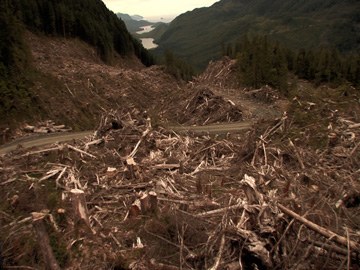
I just walked through the ‘not-a-clear-cut’ logged area between Qualicum Beach and Coombs. The second growth forest, once considered a buffer from previous logging, has just been leveled. ‘Single stem variable retention logging’ at its finest. Like sentinels left standing on a bleak and desolate landscape, a few deformed trees remain. A jumble of stumps, exposed root-balls, shattered trunks, branches, and exposed ground cover are all that remain.

Water from Hamilton Marsh flows directly into this wasteland on its way into French Creek. Heavy rains are flushing the silt, mud, and debris exposed by this logging operation into the tributaries of French Creek. Down stream are salmon enhancement projects, community water intakes, housing for thousands, and banks subject to erosion and collapse when run-off swells the creek.

This area is owned by Island Timberlands, which is owned by Brascan, which has changed its name to Brookfield. This “Global Asset Management Company” has just come out of a long strike with local forestry workers. Having logged this area they will be selling the land to a real-estate firm. In order for the unnamed developers to sub-divide and sell this land for residential and commercial uses they will have to apply to the Regional District of Nanaimo for rezoning permits to take this land out of its forest management designation. This will likely be approved unless the public takes a stand.

According to the Official Community Plan, established by the RDN and dedicated members of this community, this land is specifically reserved for forest management. The logged area closest to the Inland Highway is part of the RDN Area “G” while the clear-cut along what was once the ‘Coombs cut-off’ is in Area “F.” Rezoning would have to be approved by the RDN Board of Directors, which includes both local mayors.

The forest around Hamilton Marsh is also owned by Island Timberlands, which recently rejected a fair market value offer from the Regional District of Nanaimo in partnership with Ducks Unlimited Canada to purchase the land and protect it as park. Based on the direction Brookfield is taking, all forestland in the area will be logged and sold to real estate developers.

The provincial governments - the NDP initiated this legislation and the BC Liberals boast they have completed the task - claim they have protected 12% of the land base as parks. However, the majority of people living on Vancouver Island are concentrated along a thin corridor along the east coast from Campbell River south. In that area less than 7% of the land has been protected as parks. The primary reason is because industry and private people own most of the land.

All of the land between Victoria and Courtney along the East Coast of Vancouver Island, along with all land West to a line that runs between Port Renfrew and Port Alberni, is privately owned. In 1884 Prime Minister John A. Macdonald convinced coal magnate Robert Dunsmuir to build the Esquimalt and Nanaimo Railway, something he had promised the citizens of British Columbia in order for them to join confederation in 1871. The government in Ottawa paid Dunsmuir $750,000 cash and 2.1 million acres of land on Vancouver Island along with all mineral rights.

Over the years the E&N lands were sold to small and large companies as well as to private individuals. As a result this entire Dunsmuir land area is not accessible to the general public and remains out of the jurisdiction of all levels of government. Most streams, lakes and swamps on the east side the island are held privately, including the bed of the water body.

One way out of this land squeeze is to limit re-zoning of land to that of the OCP. As it stands, the land Island Timberlands has logged is not zoned for housing or commercial development. Should they decide to ‘donate’ the entire forest around Hamilton Marsh to the RDN as a park, then their development firms may have a chance for re-zoning. Until then the limitation of forestland remains in place.

Contact Electoral Area “F” Director Lou Biggemann and Area “G” Director Joe Stanhope at Regional District of Nanaimo 6300 Hammond Bay Road Nanaimo, BC V9T 6N2 as well as Community Planning 954-3798 E-mail: Planning@rdn.bc.ca

Thursday, November 01, 2007

HUMAN INTERVENTION CAUSES BEACH EROSION ON PUBLIC COASTLINE

Oceanside prides itself on the fact that it is located along some of the finest beaches in British Columbia. People from around the world come here to enjoy the coastline and many of them retire here after multiple vacations. As a result the population is growing rapidly and demands on the shoreline have increased.

Parksville Beach has changed a great deal since I graduated from high school. Over time pavement, fences, grass fields, and blasted rock have taken over from the natural aquatic grass and sand. A hovercraft, operating from the coast guard station at the end of the point, regularly drove out over a flat beach at low tide and launched itself into the water. Today a massive gravel bar has emerged just off shore from this same point.

According to some experts the erosion of the Parkville’s shoreline may be the result of tidal and storm pressures being deflected into the bay by this large gravel bar. As a result the city has installed sections of blasted rock to prevent the paved road from being washed away. The City of Parksville is considering more changes to the shoreline in an attempt to stop this type of erosion.

The main change to that section of coastline is the massive blasted rock causeway built by Surfside RV Resort, dividing the Englishman River Estuary Floodplains from the Strait of Georgia. Man made changes to the natural coastline effect the flow of water by redirecting tidal and storm surges. All along the coast private land owners have installed dikes, concrete walls, and other barricades in order to alter the natural erosion of the shoreline.

An area known as the ‘Queen’s Land’ along all waterways was once protected from development but today it is very easy to obtain a license which allows property owners to alter the coast. Governments at all levels have abandoned the protection of the shoreline in exchange for increased tax revenue from expensive waterfront properties. However, there remains a legal right of way along all waterways which is accessible to the general public which can not legally be blockaded by private property owners because the ‘Queen’s land’ belongs to all citizens of Canada.

In September the Stewardship Centre for British Columbia announced that it had been awarded a grant of $100,000 by the Real Estate Foundation of British Columbia for the Green Shores sustainability project. With a focus on social and economic development, the Green Shores Project aims to promote healthy coast and marine ecosystems by planning a design while working to benefit the environmental. It provides positive examples for property owners, developers and design professionals to address environmental and sustainability issues associated with increased waterfront development. Unfortunately, as a non-profit society it cannot enforce it’s recommendations but does provide information and tools to assess shoreline property and habitat protection.

“The need for sustainable approaches to waterfront development in the Georgia Basin and Strait of Georgia is accentuated by unprecedented residential and commercial growth,” said Project Coordinator Patrick Walshe. “Frequently we try to immobilize shorelines with cookie cutter solutions, yet too often this destabilizes the shore and its ecosystems, jeopardizing our coastal resources as well as the beauty and character of our coastal communities. There are many green alternatives in our tool kit, which can be catered to solve site specific issues more effectively.”

The project team will help to educate land managers, designers, planners, developers and builders working on ocean front development on Vancouver Island and the Georgia Basin, in an effort to develop alternative design concepts.
For more information visit the Green Shores website at http://www.greenshores.ca

Thursday, October 11, 2007

PLASTIC! PLASTIC EVERYWHERE!

I do a lot of hiking around the Oceanside area and it always amazes me, when at the end of a long series of logging roads or trails, to find garbage. Primarily plastic garbage. The most common are shopping bags, potato chip bags (plastic lined with aluminum), plastic used to hold aluminum cans together, car tires, and cigarette-pack-wrappers. Just take a look over the cliff on little mountain where the garbage has been piling up for years. Clean-up crews along the highway seem to be on endless duty picking up what people throw out of their cars. Littering is illegal and punishable by fine.

Most of these items are produced from petroleum, which has been refined, and then processed into products that take a very long time to disintegrate. Refining crude oil is a process whereby the most toxic and noxious chemicals are burned off into the atmosphere. A great deal of CO2 emissions are emitted prior to any oil products reaching consumers, these pollutants contribute to global warming by building on the green house gases effecting the planet’s atmosphere.

What is really astounding is finding garbage bags, twist tied and full of house hold garbage, that someone has taken this much care and attention to dump at the end of a long road in the wilderness rather than take it to a transfer station or a dumpster. Even worse, I’ve witnessed people burning plastic in their campfires as well as in barrels to get rid of household trash. Sure, it may seem easy to toss plastic bags, plastic utensils, styrofoam plates, and other plastics into the fire but the toxic fumes do contribute to green-house effects in the atmosphere. Like the canary in the mine, many species of birds have been dying due to toxins in the air we breath.

Of course the best way to avoid problems associated with plastic is to reduce the amount of plastic we consume as individuals. An easy start is at the grocery store, where millions of plastic bags are given away free. In Europe the standard has always been for people to bring their own hardy bags to the grocery store to put their products into for the trip home.

As most tourists who have visited Europe will attest, if you have no bag with you the store will sell you one for a minimum charge of $0.50 per bag. As a result most Europeans provide their own bags, this has become the norm rather than the exception. If local grocery stores began to charge for every plastic or paper grocery bag how long would it be until everyone brought their own bags. Which grocery story will start this trend? Perhaps they need some encouragement from you, their loyal customers. Many stores already provide strong durable bags at a small price.

Fleece and other polyester clothing is now available made primarily from post consumer recycled plastic materials. After all polyester is merely plastic spun together to make threads, which are then woven together into garments. Buying these recycled cloths supports an industry that is using up those plastic bags we need to reuse. By extending the use of these plastics you are preventing more crude oil from being refined to make polyester thread, less toxins in the atmosphere, less plastic to disintegrate.

Plastic containers are turned into building materials, which are now available at your local lumberyard in the form of studs and other forms of structural products. The Regional District of Nanaimo and all local municipalities have adopted a zero waste strategy, which allows the public to include plastic containers in their blue box for recycling. Those very same blue boxes are made from recycled plastic. For collection rules and more information contact: www.rdn.bc.ca

It is a well-known fact that much of the CO2 emissions are produced from car engines burning gasoline, but there are many other ways that we use oil derivatives in our daily lives. Every drop of oil represents a landscape devastated by extraction, drops spilled along the way, gases emitted into the atmosphere in the refining process, and transportation costs including oil spills. Take care with how much plastic you consume and be careful how your deal with your garbage. If you would like to report illegal dumping contact local RCMP or the RDN toll free 1-877-607-4111

If you live elsewhere I can garantee you will find similair problems on any backroads. Please let your local government know.

Friday, September 28, 2007

SAVE OUR RIVERS NOT OUR IMAGE

Today society struggles to strike a balance in watersheds that have been battered for the past 150 years by logging, development, gravel mining, and road building. Despite this, and the fact that water is a precious resource, the destruction continues.

For many years now the Englishman River has been considered one of the top most threatened rivers in BC according to the Outdoor Recreation Council of British Columbia, with a total of 120,000 members. (www.orcbc.ca) Englishman River is considered to be an example all of the rivers on the east coast of Vancouver Island, that flow into the Strait of Georgia Basin. All of these rivers are in a serious state of stress and decline.

The indicator species used by many biologists to determine the health of these rivers is the Steelhead Salmon, a species that returns to spawn many years in a lifetime. Snorkel teams counted 471 adults in February 1985, which was cause for alarm at the time since the returns once numbered in the thousands. By the year 2000 the winter count was 15, a count that went up to 43 in 2006.

A lot of attention has been directed at the Englishman River to try to bring the salmon back. A ‘salmon enhancement’ program has involved diverting water into excavated channels, ditching, egg and milk extraction, incubation pens, and fry release.

Multinational logging companies, TimberWest and Island Timberlands, continue to destroy the banks of local rivers with tree removal and road building. The resulting landslides, land erosion, and surface disruptions lead to massive amounts of dirt and debris in the flow of water. Heavy rains flush silt, loosened by logging equipment and dragging of logs, into rivers. Buildup of silt is known to suffocate salmon eggs buried in gravel. Channeling of water results in higher floods, which further erode riverbanks and level out pools.

Over the years governments have addressed some of the issues that face the watersheds locally but they tend to avoid drawing attention to the root causes of the damage. Instead, they claim that logging corporations provide valuable money for rehabilitation. These logging companies get massive tax breaks in exchange for money that is put into river restoration projects.

In the case of Englishman River attempts have been made to recreate pools and safe refuge for small salmon fry that get washed away when the river gauges out straight wide expanses between ever widening banks. These projects involved massive excavators, dump trucks, blasted rock, steel cables, logs with rootballs purchased from logging companies, chainsaws, and of course manpower paid with provincial and federal tax dollars.

River restoration, while logging the banks of the very same river, is similar to sticking a knife into your stomach and then trying to cover it over with band-aids rather than pulling out the knife and then attending to the wound.

Fisheries and Oceans Canada manages fish. The BC Ministries of Forests and Environment do not regulate logging on private land. The Regional District of Nanaimo is responsible for the dam at the source. Logging companies, various developers, and private landowners all stake their claim to the land on the banks of the river. Who is looking after the interests of the river and watershed?

On BC and World Rivers Day Sunday, September 30 much attention will be directed at the new Top Bridge Crossing where the Regional District of Nanaimo will be kicking off the grand opening of the new Englishman River Regional Park. Having spent $500,000 on a steel suspension bridge you can be sure to find many politicians.

Meanwhile a group of dedicated volunteers will be providing tours along the floodplain of the Little Qualicum River where Chinook Salmon are currently spawning. Sarah Casley, Education Coordinator for Fisheries and Oceans Canada will be performing a salmon dissection beginning at 11:30am. The largest Sitka Spruce on the east coast of Vancouver Island is hidden inside this jewel of a forest. Access is at the end of Kingkade Road just north of Qualicum along the Island Highway. The Little Qualicum River has received very little attention from local, provincial or federal government and continues to be threatened by development and logging.

Friday, September 14, 2007

AERIAL GARDENS IN THE ANCIENT CANOPY

On the Labour Day weekend I climbed the largest Douglas fir tree in the world, actually I took the elevator up. In order to operate my video camera I work with a team of professional tree climbers, all of them arborists, who rig the ropes. They hook my harness up to a rope while another climber, who has climbed up the tree beforehand, is attached to the middle of the same rope. A pulley allows him to act as my counterweight and a ground crew uses the rope to pull him down to the ground. I am lifted gentle up into the crown of the tree.

Moving up along the massive trunk of this Fir tree reveals deep grooves woven randomly in the bark, some as deep as 6 inches. Spider webs span these ravines, shimmering in the light. Many species of lichen adorn the brown/grey bark with bright splashes of white, green, and yellow. I float by the remains of a nest made by a tiny bird, perhaps a winter wren, fitted snuggly in a hole bored by a woodpecker.

At about 100 feet a lush aerial garden is wedged into the crotch where the first branch juts out from the trunk. Licorice ferns pock out of the thick mat of moss and lichens that clings to the top of this massive bough. The bright red dots of huckleberries contrast with the various shades of green and yellow moss as 3 huckleberry bushes stand firmly in the breeze. A 4-foot hemlock tree dominates this suspended paradise.

The Red Creek Fir is a ‘World Champion’ tree with the greatest volume of its species in the world. This is according to the Big Tree Registry of British Columbia, which lists the top 10 trees of every species. www.env.gov.bc.ca/bigtree For some reason this Fir was allowed to stand while the forest around it was completely leveled by clear-cut logging, in fact the old logging road runs past the base of this incredible tree. This giant is 13.28 m (43’7”) in circumference, 73.80 m (242’) tall, with a crown spread of 22.80 m (75’)

I continued up the elevator to approximately 150 feet where the view of the San Juan Valley is incredible. Unfortunately gaping holes in the forest below reveal recent clear-cut logging in second growth forest. The entire valley has been logged and now Western Forest Products (WFP) is logging the area for the second time, faster, with larger machinery, and fewer workers.

We then moved to the other side of the valley where the San Juan Sitka Spruce grows. This is the largest Spruce in Canada with an 11.66 m (31’5”) circumference, height 62.50 m (205’) and 23 m (75’) crown spread. The massive trunk branches into several adjacent trunks, which are larger than many large trees.

Once the ropes were rigged I had to do some work and climbed a rope 200 feet to the top of this tree. Along the way I stopped frequently to admire the many aerial gardens along the way. Many large branches protrude from the trunks of this tree, providing platforms of moss, ferns, and small bushes. These platforms are ideal habitat for Marbled Murrelet, a red listed endangered sea bird which nests only in old growth forests.

Looking down at the San Juan river I am surrounded by many aerial gardens teeming with life. I am astounded to see two 3 foot tall ‘bonzai’ Douglas Fir trees growing out of the top of the main trunk which was blasted off by lightening many years ago. A 14 foot tall hemlock grows off another trunk, along with many smaller trees, bushes, ferns, moss, and lichens.

I’ve been climbing trees for a few years, pulling together a team that is allowing me to shoot a film about the canopy of the ancient rainforest of Vancouver Island. The climbing system we use allows me to move into the canopy with the least amount of damage to the tree since the gigging ropes are what my team and I climb on with only a few points of contact with the tree itself.

I have climbed with several researchers, including a team of Entomologists from UVIC who have been climbing into the canopy where they have discovered no less than 125 species of insect that were previously unknown. For more information: http://web.uvic.ca/~canopy

This abundance of evidence proves that we know very little about the ancient rainforests. 85 of 91 watersheds on Vancouver Island have been heavily logged and less than 5% of the low valley bottom forest remains intact.

Tuesday, January 23, 2007

FEDERAL ENVIRONMENT MINISTER PROMISES CHANGE - LETS HOLD HIM TO IT

Canadians are demanding immediate attention to protect the environment and Prime Minister Stephen Harper claims to be listening. He has appointed a new Minister of Environment, John Baird, to address the many concerns Canadians have about the environment.

In anticipation of an upcoming national election the rhetoric is flying and promises are being made. Today the iron is hot and any input will receive some attention from the office of the new minister. I encourage you to contact him. It is always wise to send a hard copy by snail mail but remember that e-mail, fax, and phone will each be processed by a different civil servant. The more people in the office that are made aware of your concerns the better. CC to related ministers at the same mailing address. Here is my letter welcoming the new minister:

The Honourable John Baird
Minister of the Environment
House of Commons
Ottawa, Ontario K1A 0A6
Telephone: (613) 996-0984
Fax: (613) 996-9880
E-Mail: Baird.J@parl.gc.ca

Dear Minister,

I am glad to hear Prime Minister Harper is finally beginning to listen to the people of Canada with regards to the Environment, and has appointed you to this important portfolio. It is time that the federal government of Canada fully implements the Kyoto Protocol to which Canada is a signatory.

Living in British Columbia I am very concerned about three key issues that are currently being initiated by the provincial government and which should be stopped by your office, since they affect the country as a whole and therefore must comply with Canadian standards for the environment.

The public has been led to believe that offshore drilling in the coastal waters of British Columbia has been put to rest by the federal government’s continued support of a moratorium. However, the BC government continues to allow sonic testing on the ocean floor and acts as if the moratorium will be lifted in the near future. I encourage you to stand firm by maintaining the moratorium on offshore oil and gas explorations in BC. In 2004, the federal government asked British Columbians their views on the moratorium through a public process that involved 3,700 individuals, many of whom work and live on the coast of B.C. Seventy-five percent of the participants told the federal government they wanted the moratorium on offshore oil and gas maintained. 70 BC First Nations were involved in this review, all of them support the moratorium. BC voters continue to says no to offshore oil and gas.

Put pressure on the BC provincial government to stop plans to build 2 coal-burning power generated and associated open pit mines. On December 21, 2006 Environment Canada released new greenhouse gas emissions data showing that across Canada in 2005, coal-fired generating plants belched out 280 million tonnes of greenhouse gas emissions and remained among the nation's biggest polluters. Since your office is committed to reducing gas emissions you must stop the BC government from building new coal-burning generators.

Stop all logging in what little remains of old growth forests in Canada. Science has determined that forests are extremely important to the life cycles and functions of this planet. Trees filter air by taking carbon, nitrogen, phosphates, and other airborne chemicals in the atmosphere and fixing them into the soil where they can provide nutrients, in turn producing vast amounts of oxygen. Rainforests redistribute water, functioning as huge sponges to retain water and pumping vast quantities of water back into the atmosphere. Large tracts of intact forest help to stabilize weather patterns both locally and globally. Biologists have also determined that a ‘healthy forest’ is made up of trees that are multi-aged, multi-species, multi-sized, and multi-layered. These types of variations are only found in old growth forests and are not found in tree plantations. In fact scientists have determined that the rainforests found in the low valley bottoms on the west coast of Vancouver Island have a biomass greater than anywhere on earth, meaning that the density of living organisms per square meter surpasses even the famous Amazon rainforest. On Vancouver Island less than 10% of the original old growth forests remains, they must be protected.

It is time that our federal government gives priority to protecting the environment. I encourage you to act as do most of the people that I know.

Sincerely, Richard Boyce, BFA, MFA
Errington, British Columbia

cc. Gary Lunn - Minister of Natural Resources (Lunn.G@parl.gc.ca)
Stephen Joseph Harper - Prime Minister (Harper.S@parl.gc.ca)

Wednesday, December 27, 2006

BC ENVIRONMENTAL SUMMARY 2006 - YOU MAKE A DIFFERENCE

“We affect the environment - for better or for worse”
2006 was a big year for environmental issues, both locally and provincially.

In April Environment Minister Barry Penner announced that his government would not proceed with plans to build a parking lot in Cathedral Grove. Logging along the sensitive Cameron River floodplain has not commenced, neither has the expansion of the park been publicly marked with new signs, and no legislation has been passed to formerly protect this sensitive ecosystem.

The logging of Hamilton Marsh has been put on hold while the RDN negotiates with Island TImberlands (owned by Brookfield formerly Brascan)

A Parksville Qualicum Water Conference entitled “Our Water, Our Future” looked at the local and global issues facing drinking water, a follow-up conference in 2007 will work towards solutions.

Fisheries and Oceans Canada is responsible for protecting riparian corridors, along the waterways of this region, in order to protect key fish habitat. Timberwest has logged to the banks of the Englishman River across from Morrison Creek and the Salmon Enhancement Canals. Island Timberlands Helicopters have logged the narrow steep banks of the Cameron Rivers, in an area know as Cathedral Canyon. Island Timberlands also plans to log the steep slopes directly above Englishman River Falls Provincial Park.

A private land owner built a house in Squitty Bay provincial park, on Lasqueti Island. After a public outcry Barry Penner, Minister of Environment responsible for BC Parks, gave notice to this squatter and allowed her 6 months to move out. Today the house remains as does the squatter. The BC Liberal government continues to move towards the privatization of BC Parks which will allow private operators to build and charge for services within publicly owned parks. Who will grant these rights and monitor that the parks remain accessible to the public?

East Creek, Carmanah Valley, and three watersheds in Clayoquot Sound are all that remains of the intact ancient rainforest on Vancouver Island. This year logging began in East Creek and the Clayoquot Sound watersheds, despite the fact that most people believe that these areas are protected by the BC government. Logging licenses on these publicly owned lands have been granted by the BC Ministry of Forests.

The Great Bear Rainforest deal was signed at the beginning of the year and was to protect the largest intact temperate rainforests in the world. A public relations campaign initiated by the BC Liberals has worked to win over BC voters and tourists alike as is evident by the ‘artistically’ painted Spirit Bears found all over Victoria and Vancouver. The reality is that the deal to preserve 1.8 million hectares of land along B.C.'s Central and North Coast is falling apart as Timber companies increase the rate of clear-cut logging to unprecedented levels.

More trees were cut down in 2006 than in any year in the past. Raw Log Exports have increased, the annual allowable cut has increased, and the number of forestry job has been cut dramatically. BC Ministry of Forests sells our trees at extremely low prices to logging companies. Low stumpage fees allow for the price of exported wood to be considerably lower than competitors south of the border. Ironically Timber companies continue to post massive profits. The soft-wood lumber agreement, being signed and negotiated by provincial and federal Forest Ministers, does not include raw logs. The closing of many saw mills through-out BC is directly related to the disagreement and has allowed for the increase in raw log exports.

Fish Farming expansions continue to be approved by the BC government despite evidence that escapee’s, sea lice, excess feed, and contaminants produced by these fish pens are causing the death of wild salmon stocks.

The abundant shellfish found on the beaches around Hartley Bay have been contaminated by diesel fuel that continues to leak from the sunken BC ferry Queen of the North, once again proving that disasters do happen in the coastal waters of BC. The lifting of a federal moratorium on off-shore oil explorations has been a priority for Premier Campbell’s government who plan to have oil rigs and massive oil tankers navigating these same waters regularly.

The United Nations called for a ban on all dragnet fishing. Fisheries and Oceans Canada has thus far ignored this pleas to protect the ocean floors, despite scientific evidence that show that coral and other bottom dwelling organisms provide the basis for the existence of life in the ocean.

Premier Gordon Campbell’s government has said no to wind and solar energy, instead pushing forward plans to build two massive coal burning furnaces and associated open pit mines. Despite the PR spin put on this issue, scientists conclude that coal burning furnaces to generate electrically is the single dirtiest (in terms of pollutants such as NOx, SOx, mercury, etc.) and highest generator of CO2 of any form of power generation.

You may have already had an impact on these issues, or you could help to change them in the future. Individuals do change the world. Let’s make 2007 a HAPPY NEW YEAR!

Friday, November 24, 2006

PRIVATE MILL WREAKS HAVOC OVER ERRINGTON

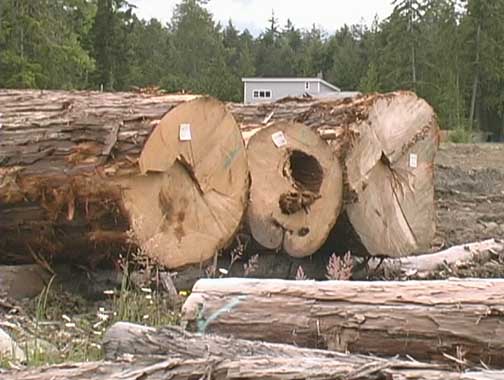
LOGS FROM YELLOW CEDAR TREES THAT GREW FOR OVER A THOUSAND YEARS ARE BEING MILLED BESIDE RESIDENTIAL HOMES IN ERRINGTON, B.C.

7 am - the beep of my alarm clock is drowned out by the piercing beep of several massive front end loaders backing up, their engines roar as they lift massive logs, their tires spinning in the mud. I listen to the Errington Cedar Mill, a full 500 meters away, as the giant wood chipper grinds into action. A loud noise similar to standing beside an old blender grinding nuts or a belt sander tearing into a piece of wood. Very loud, very grating on the nerves, with bursts of 1 to 2 minutes every 10 to 15 minutes between 7 am and 5 pm wee days and often on week-ends. Each time the chipper spins to a halt, it is drowned out by the constant drone of saws, edgers, and planers. Trucks honk, chain saws roar, and the log loaders continue to roar and beep incessantly.

Years of public consultation, during which countless residents voluntary dedicated their time and energy, resulted in the official community plan (OCP) for Area F, which was legally drawn up by the Regional District of Nanaimo in 1999. This document designates most of Errington as Rural/Residential with the “Village Centre” being the most densely populated as well as the cultural and social hub of activities since the early 1900s. However the RDN has allowed heavy commercial industry to grow unchecked in the heart of Errington. In fact industry is consuming the heart of this community.

I regularly meet fully loaded logging trucks on Grafton Avenue, which has no paved shoulder and is not designed for heavy commercial traffic. I can only imagine the choice left to a school bus driver when facing one of these massive logging trucks. The rural residential make-up of Errington means that Grafton is frequented by horses, cyclists, children, and parents with infants in strollers.

These logging trucks bypass the old Alberni highway, designed for commercial traffic, in order to dump their logs at a new dry land sort leased out by the Errington Cedar Mill. The logs are then reloaded and once again driven through the heart of this community seven days a week including holidays. Chip trucks, logging trucks, and loaded flatbeds all make a very wide turn at the Errington store taking up several lanes at this busy intersection, which most residents of Errington must drive through daily.
Officials at the RDN admit that no changes have been approved for the property yet the original zoning mentions only a single sawmill as the permitted principle use. Albert Orcutt started Errington Cedar Products with Brad Meeker, owner of Meeker Lumber Ltd. of Mission, B.C. Together they have been able to secure 5 million board feet of old growth Western Red Cedar and Yellow Cedar logs annually.

While attending Errington Elementary School my class took field trips to the 14 acre farm next door where we observed a large sow pig with a litter of tiny piglets, cows being milked, and other animals in the barnyard. The ALR allowed the land to be stripped of most of the topsoil, watched a massive mill be built, and much of the area to be paved. After all of this the ALR approved the removal of this property from farm status on the grounds that the property could no longer support a farm.

This summer all of the trees at the back of the property were removed, the soil piled up, and a new road pushed in along the property lines of several long time residential homes. Ditches were gouged out along Christian Road to increase the drainage away from the mill. The dust retardant promised by the Ministry of Transportation was never applied as fully loaded trucks roared up and down the new road, sometimes well into the night. Some arrangement has been made so that logs are being sorted and scaled in downtown Errington, surrounded by residential homes, at a new land sort.

Designated industrial zones allow for residential and environmental concerns to be addressed while providing industrial grade infrastructure, safe highway access, and better emergency response. An OCP is meant to be strictly monitored and enforced.

If you have concerns please contact RDN Community Planning (250) 954-3798 E-mail: planning@rdn.bc.ca and/or local MLA Scott Fraser Toll free: 1-866-870-4190 E-mail: scott.fraser.mla@leg.bc.ca and/or Ministry of Transportation Barbara Thomas (250) 751-3126 E-mail: barbara.thomas@gov.bc.ca

Friday, November 10, 2006

WATER FLOWS INTO PEOPLE’S FUTURE

EMERALD LAKE FROZEN OVER BELOW MOUNT ARROWSMITH

Many of the trails I frequently use to walk along the banks of Englishman River were flooded as I made my way along the swollen waters near Top Bridge municipal park. “The nose” was level with the roaring water, brown with silt from fresh logging cut-blocks up stream. The week before I stood on top of the same rock shelf and noted that I would not want to dive for fear of hitting the bottom because the water was so shallow. That means the water rose approximately 5 meters in about 2 days. What a difference a week-end can make!

After many months of drought the rain finally came on the same week-end when water was the focus of a Parksville Qualicum Water Conference entitled “Our Water, Our Future”, attended by more than 350 people at the Qualicum Beach Civic Centre. Opened by Qualicum Chief Kim Reculma-Clutesi, who welcomed everyone and encouraged people to come together to protect water, the importance of drinking water as a global and local issue was raised.

According to the leaders at Kyoto: “We are water warriors.” This is a human issue and only human beings can resolve the vast number of problems, most of which we have created. Act locally, think globally is an old catch phrase that is appropriate.

Severn Cullis-Suzuki pointed out that a litre of water can cost more than gas and produces a plastic container that is added to the 2.5 billion discarded every year. She suggested that using a personal reusable cup to drink coffee would help reduce the number of throw away cups which, if placed end to end, would circle the planet 7-8 times annually. 45,000 gallons of water are used to produce a single car. Cullis-Suzuki inspired the crowd with her stories of people from around the world coming together to protect the environment.

The largest aquifer on the planet lies under Brazil, Argentina, and Uruguay. When private corporations and government tried to privatize the drinking water in Uruguay, three million people protested. As a result the constitution was re-written after a 67% plebiscite to stop privatization and protect water. The constitutional amendment states:” Water is a human right.”

A statement from the UN indicated: “The wars of the 21st century will be fought over water!” Tony Clarke, Executive Director of the Polaris Institute, ended his speech with: “Water must never be completely controlled. Water must flow freely.”

Tofino councillor Michael Tilitzky explained that bylaws now make it mandatory to use dual flush toilets which use 3 litres per flush rather than the traditional 13.5 Why is this not a provincial law? Tofino is thinking beyond pipes and pumps by focusing on conservation as the solution to the problems of water shortages and increased demand on the limited drinking water supply.

Logging continues to effect local water by reducing the natural forest filters, eroding top soil, and reducing snow packs. Water flows without regard to boundaries yet is treated differently depending if it flows through private or public land. The ‘Private Forest Land Management Act is currently under review. This legislation establishes logging, road building, development, and other regulations for private land. Public input is needed. Voice your concerns to: BC Forest Minister Rich Coleman FOR.Minister@gov.bc.ca (250) 387-6240

Near the end of the workshop portion of the conference people came together to come up with positive tasks for people to work on to change the current status of water. Some of these included: Amending the Canadian Constitution to include “Drinking Water is a Human Right” This would create protection for water from the highest level and trickle down to every aspect of Canadian living. Lobby the local Health Authority to enforce water protection, particularly industry. Call for legislation to protect the water aquifers and ground water in this province.

Consensus was to hold a follow-up conference which will focus entirely on building solutions to the many issues facing water. Keep an eye out for information and checkout www.arrowsmithwatersheds.org

Friday, October 20, 2006

WHERE IS THE FALL SESSION OF THE BC LEGISLATURE PROMISED BY CAMPBELL'S LIBERALS?


CATHEDRAL GROVE REMAINS UNDER THREAT FROM BC LIBERAL UNTIL LEGISLATION IS PASSED

To date the boundaries of internationally renouned Cathedral Grove Provincial Park, located between Qualicum Beach and Port Alberni on Vancouver Island, have yet to be written into legislation. The sign welcoming people into the park has not been moved 3 km towards Port Alberni to reflect the new park boundaries.

The fact that BC Minister of Environment Barry Penner has made several public announcements regarding the park, none of these statements are reflected in law today. According to the BC Liberals this park has doubled in size, no parking lot will be built on the much protested location, and parliament will be held in the spring and fall of every year in order to legally pass legislation into law.

Political debates that are supposed to mark democracy in this province have somehow faded away. The Fall session of the legislature has been canceled with no fanfare and the Legislative Assembly remains silent.

When the BC Liberals were elected in 2001 they made many promises. They guaranteed that the Legislative Assembly would hold both a Spring and Fall session, establishing a parliamentary calendar which scheduled 11 week in the spring between February 14 and May 18 and 7 weeks in the fall between October 2 and November 30. This year there will be no fall session. The BC Liberal government has stated very little publicly about this major omission in how government is run in BC. Mass media seems to have missed this story completely.

Members of the Legislative Assembly (MLA) each hold a parliamentary seat in the House where they meet in order to debate how this province is governed. All government policy and laws must be approved by a majority of MLAs. On average each MLA in B.C. represents a little more than 47,000 people. The current, 38th parliament has 79 MLAs of which 34 are members of the NDP and 45 are of the BC Liberal party.

While browsing www.leg.bc.ca I read through a document entitled; “Discover Your Legislature Series” and was able to glean a few important quotes; “When the House is sitting, MLAs are responsible for studying, debating and voting on all bills (proposed laws) put before them.”

Under the heading ‘Introduction of Bills’ it is stated; “Throughout each session, new legislation is debated through a series of ‘readings’ before finally being voted on and, if approved, given Royal Assent by the Lieutenant Governor... Debate on government bills can last any length of time, but passing them before the end of each session is crucial. If that cannot be done, then the bill will “die on the order paper,” meaning it will have to be reintroduced in the next session and go through the legislative readings all over again.”

Today, with a slight majority government and no fall session of the Legislative Assembly, the BC Liberals continue to act on issues that are of great significance to the future of all residents of British Columbia. A few examples include Canada’s soft-wood lumber agreement with the USA, treaty negotiations with Tsawwassen First Nations, salmon farming, a return to the burning of coal, off-shore oil exploration, health, welfare, education, transportation, raw log exports, privatization of BC parks, and many more issues that are not being debated this fall by representatives elected by BC voters.

Political assurances are only as good as the paper they are written on and all bills must have Royal Assent before they become law. A parliamentary session must be held in order for government to act on any new legislation. Voice your concerns with the Lieutenant Governor of BC the Honourable Iona Campagnolo GHInfo@gems6.gov.bc.ca and/or Premier Gordon Campbell premier@gov.bc.ca phone: (250) 387-1715 and/or Minister of Environment barry.penner.mla@leg.bc.ca phone: (250) 387-1187